Meeting Ofsted’s ‘Inclusion-first’ standard
30 April 2026
The goalposts for school inspections have shifted. Under the revised Ofsted framework, the evaluation of Pupil Premium (PP) spending has moved toward a more holistic, “inclusion-first” model.
For school leaders, this means it is no longer enough to show that a strategy exists; you must demonstrate how that strategy translates into the lived experience of your most vulnerable pupils. With a new standalone evaluation area for Inclusion, the scrutiny on how we support disadvantaged learners has never been higher.
The shift to ‘lived experience’
One of the most significant changes in the framework is the move toward case sampling. Inspectors are now specifically looking at vulnerable pupils to track their progress against the school’s stated strategy. They aren’t just asking what you bought with your Pupil Premium funding; they are asking how that intervention feels to the child.
Does it make them feel valued? Does it address their specific skill gaps? Does it foster a sense of belonging and academic confidence?
Meeting the ‘strong’ standard: Lessons from St Ursula’s Convent School
St Ursula’s Convent School recently navigated this new inspection landscape, securing a “Strong Standard” in Achievement in November 2025. Their journey offers a blueprint for how schools can use high-quality tutoring to satisfy the “inclusion-first” criteria.
Steve Muzio, Key Stage 4 Director at St Ursula’s, noted that Ofsted visited an Action Tutoring session specifically to see the school’s strategy in action. “Inspectors could see we were making progress with harder-to-reach families,” Steve explained.
“I was able to explain how the Action Tutoring baseline assessment helps us identify and target specific skill gaps. This was a key lever in us securing a ‘Strong Standard’.”
Steve Muzio, KS4 director at St Ursula’s Convent School
Watch: St Ursula’s journey to a ‘Strong Standard’ in Achievement
How Action Tutoring supports the new framework
To meet the “Expected” and “Strong” standards for Inclusion and Achievement, your Pupil Premium strategy needs to be evidence-based, data-informed, and pupil-centered. Here is how the Action Tutoring model aligns with these requirements:
1. Quantitative rigor: Data-informed tutoring
Ofsted looks for strategic intent. Our model uses baseline assessments to pinpoint exact areas for development in maths and English.
At St Ursula’s, this allowed leadership to present a clear, cumulative strategy to inspectors, showing how external intervention “plugged the gaps” that internal teaching had identified.
2. Qualitative impact: Confidence and wellbeing
Inclusion is about more than grades; it’s about how a pupil perceives their place in the school. Steve observed a significant shift in pupil wellbeing: “The pupils see this intervention as a tangible sign that the school is actively listening and investing in them. It makes them feel valued.”
This “inclusion-first” outcome is exactly what inspectors look for during pupil voice interviews and case sampling.
3. Reliability and quality
The new framework values partnerships with a proven track record. By partnering with an award-winning charity undergoing a rigorous EEF evaluation, schools can demonstrate they are using “high-quality, affordable” routes.
As Steve put it: “The tutors are well-vetted, knowledgeable, and have the strong subject backgrounds required to teach the specific areas where our pupils need the most support.”
Reducing the burden on staff
A common concern with intensive inclusion strategies is the impact on teacher workload. The “Inclusion-first” standard shouldn’t come at the cost of staff burnout.
The Action Tutoring model is designed to be “logistically light” for school leaders. With an on-site Programme Coordinator (PC) acting as the primary contact, staff at St Ursula’s found they could oversee the start of a session and then leave it in the PC’s hands. “Knowing there is a trusted adult in the room allows me to get on with my day,” says Steve.
A core component of excellence
As the framework continues to evolve, the schools that succeed will be those that integrate their Pupil Premium strategy into the very fabric of their school culture.
At St Ursula’s, tutoring wasn’t an “add-on” – it was a primary lever for recovery and achievement. By providing tailored, evidence-based support, they didn’t just pass an inspection; they ensured their most disadvantaged pupils were no longer “against the tide,” but riding it toward a brighter future.
Is your Pupil Premium strategy ready for the new Inclusion standard?
Related content:
A conversation with Maro Itoje
23 April 2026
What happens when world-class leadership on the rugby pitch meets a relentless passion for social justice? You get a partnership designed to “power potential” in the heart of our communities.
In 2025, The Pearl Fund – the philanthropic initiative founded by British Lions and Saracens Captain Maro Itoje – expanded its work into the UK, partnering with Action Tutoring to deliver targeted academic support for young people facing disadvantage.
Rooted in Maro’s British-Nigerian heritage, The Pearl Fund was established to widen access to education across both Nigeria and the UK. The Pearl Fund was launched in 2023 in Nigeria which is home to some of the highest numbers of out of school children globally. Currently, the Fund supports 40 children in one of Lagos’ most deprived areas from cradle to college with financial support for their families, clean water, and nutrition. Keen to support in his country of birth and recognising the widening attainment gap in the UK, Maro chose Action Tutoring as the Fund’s first UK charity partner to deliver targeted educational support to young people in London.
Alongside this work, the Fund’s expansion into London reflects a growing need for targeted academic support closer to home. In England, the attainment gap between disadvantaged pupils and their peers remains significant and, in recent years, has widened. In boroughs such as Tower Hamlets, where this programme is focused, progress sits alongside persistent inequality, with many pupils still facing structural barriers to achieving their full potential, particularly in the wake of the pandemic.
To deliver impact in the UK, The Pearl Fund selected Action Tutoring as its first delivery partner – bringing a proven, evidence-based approach to supporting pupils in maths and English. Together, they are now supporting over 30 primary school pupils in East London through targeted tutoring.
On 25th March, Maro visited St Paul’s Way Trust and The Clara Grant Primary School to see the programme in action. We sat down with him to discuss why this mission is so personal, the “heart-filling joy” of the classroom, and why education remains the ultimate tool for self-determination.

Why did you start The Pearl Fund?
We started The Pearl Fund because I’ve always felt a responsibility to give back – but to do it in a way that is sustainable, long-term, and where you can clearly see the impact on young people’s lives.
Why did The Pearl Fund decide to partner with Action Tutoring?
We were looking to partner with a UK-based organisation to help deliver our programmes in London. The Pearl Fund is all about education, and there were so many synergies with what Action Tutoring was doing – particularly in the education space and with this tuition programme.
Once we started talking, it became clear that Action Tutoring was the right fit for what we were trying to achieve.
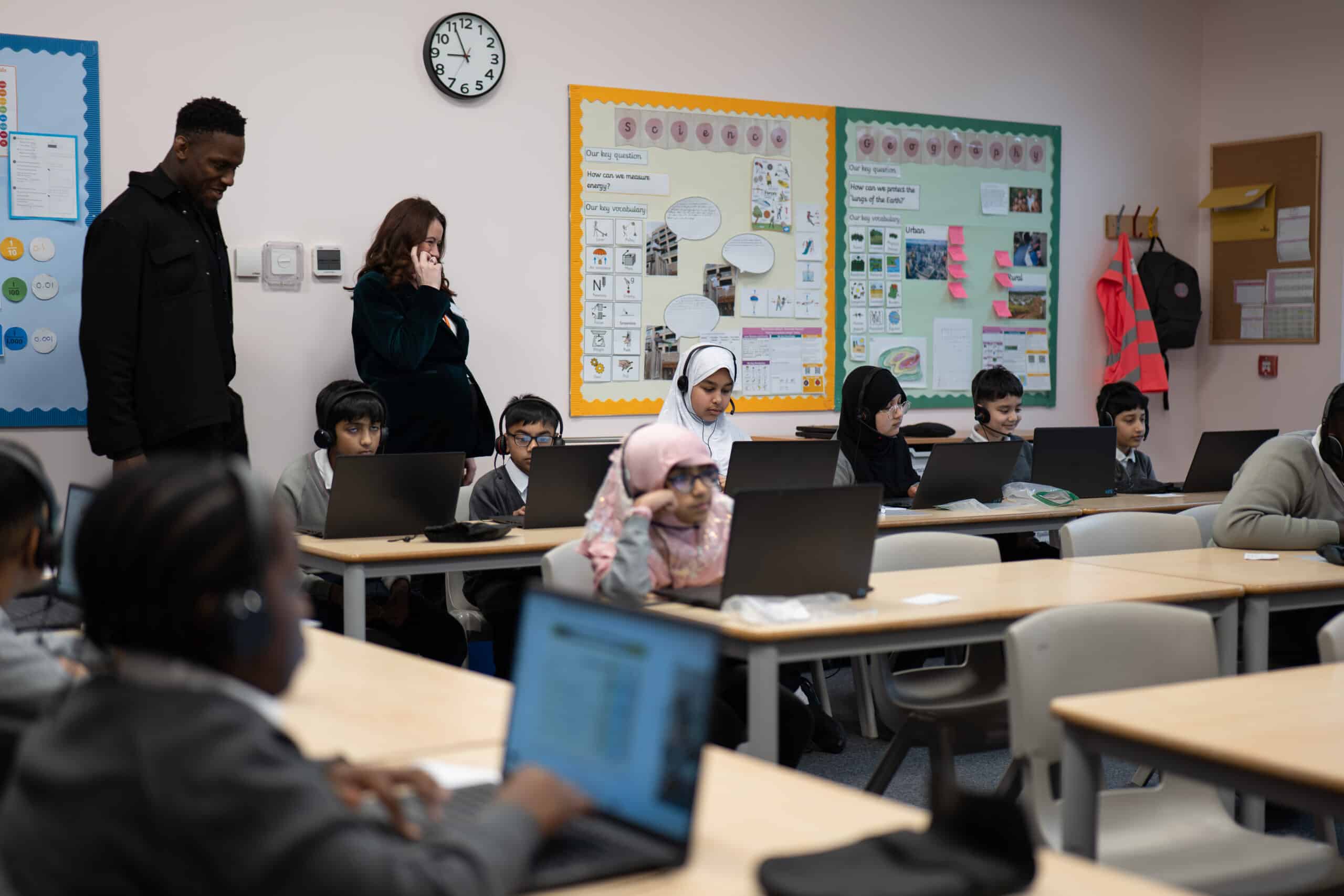
How was it seeing a tutoring programme in action today?
I was very impressed. Very impressed by the children, by the tutors, and the work that they’re doing. It filled my heart with joy to see how engaged the children were and how much they were enjoying it. I’m very happy that I came to see it.
What difference do you think it will make for the pupils on the programme?
I think the difference it will make is enormous. These are children facing learning challenges, often from difficult socioeconomic backgrounds, so they are doubly disadvantaged. It could be the difference between passing and failing their exams.
At the age they are, it’s critical that they catch up. I was told today that many are still impacted by the effects of Covid – both in terms of their learning and the environment they were learning in. Programmes like this help accelerate that development.
What are your hopes for these pupils’ futures?
To pass their exams and to grow in confidence. But my long-term hope is that they are able to take control of their own stories. That their education gives them the ability to choose their path – whether that’s through school, university, or another route. When you have an education, you have that freedom.
What would you say to the current volunteers?
Keep going; the work that you’re doing is amazing. It is well-appreciated by the kids and everyone else involved in the programme. They’re a fundamental part of this programme because without the volunteers we wouldn’t be able to do this, so thank you.

What would you say to anyone considering volunteering as a tutor?
I think with all this type of work, you often end up getting more from it than the children! The children definitely benefit and the impact on them is huge, but in terms of what the volunteers get from it: what they experience fills their heart with joy. So, I would encourage any volunteer who is thinking about it: I think you should just try it, and if you try it, I almost guarantee that they will stay in the long term.
What would you say to schools considering programmes like this?
Do it, because the impact on the kids will be amazing! The impact on their education and their future lives will be amazing, and I think the evidence is there for all to see. I would encourage all the schools who are considering it to go for it.
Finally — why does a good education matter?
I think it is potentially the greatest vehicle we have as human beings for progression. It’s something that cuts across socioeconomic backgrounds. It cuts across borders. It cuts across race or any other social demographics. It ultimately gives individuals the power and the ability to control their future destiny, and that’s what we all want as individuals. Education is key to that.
A legacy beyond the pitch
Maro’s visit serves as a powerful reminder that the attainment gap is not just a statistic – it is a hurdle that can be cleared with the right support. Throughout our conversation, Maro highlighted that tutoring is “the difference between passing and failing” for pupils facing double disadvantages, particularly those still navigating the “learning scars” left by the pandemic.
His message is clear: education is the “greatest vehicle for progression” because it transcends borders, socioeconomic status, and race. By providing pupils with the tools to “control their future destiny,” the partnership between The Pearl Fund and Action Tutoring is doing more than just improving test scores; it is giving young people in East London the agency to write their own stories.
As Maro noted, this work wouldn’t be possible without our volunteers. Whether you are a school leader looking to close the gap or an individual looking for a “heart-filling” way to give back, the evidence is there for all to see: tutoring works.
“The tutoring has already had a positive impact on our pupils. We are seeing growing confidence, stronger engagement in lessons, and a renewed excitement for learning. Children who may have struggled are now participating with greater pride, and they’re making meaningful progress both academically and personally.”
Rubel Aloum, Principal, Clara Grant Primary School
Find out more
To find out more about The Pearl Fund and their work, please visit The Pearl Fund website.
New independent study identifies Action Tutoring’s powerful impact
16 April 2026
A new independent study has found strong “evidence of promise” for Action Tutoring’s Year 6 maths tutoring programme. The study, undertaken by the National Foundation For Educational Research, found positive trends in attainment for pupils facing disadvantage and identified specific areas with statistically significant high impact.
The key results
The evaluation focused on pupils eligible for Free School Meals (FSM).The size and direction of the programme’s impact highlight the positive potential of Action Tutoring’s Year 6 maths programme on the academic outcomes of pupils facing disadvantage:
- Positive attainment trends: On average, Free School Meal (FSM) pupils in partner schools scored 1 point higher in their maths SATs than the control group, which is equivalent to +2 months of additional progress.1 While 1 point may sound small, the gap between ‘working towards’ and ‘meeting’ national expectations is often only a few points. This 1 point increase represents a vital step in closing the attainment gap for pupils eligible for Free School Meals.
- Individual pupil impact: When adjusted to estimate the effect on individual tutored pupils, the impact rose to an estimated +4 months of additional progress.2 This effect size is aligned with other small group tutoring studies.
Whilst these findings missed the threshold for statistical significance due to sample size limitations, these positive effect sizes underline the strong potential for our programme’s impact on disadvantaged pupils.
Where we saw the biggest gains
The study highlighted specific areas where the programme was exceptionally effective:
- Regional success: FSM pupils in partner schools in the South East and South West achieved statistically significant gains of +7 months of progress (p=0.02).3 Further research into the practices of tutors working in these regions may generate beneficial knowledge for all primary-aged small group tutoring.
- The power of attendance: Exploratory analysis on partner schools with high attendance (over 84%) saw statistically significant school-level gains equivalent to +2 months of progress (p=0.01) for FSM pupils.4 This affirms that when children show up consistently, Action Tutoring’s programme delivers results.
Understanding the research
This was a quasi-experimental study. Data from our partner schools was compared with a control group of similar schools identified through the National Pupil Database. Schools were carefully matched based on characteristics including size, % of pupils accessing Free School Meals, location, and past exam results.
A note on statistical significance
In research, statistical significance is a maths-based threshold used to indicate that a result is unlikely to have occurred by chance. While overall results were very positive, the main findings missed this technical threshold because the “sample size” (the number of schools involved) was relatively small.
The evaluators noted that the lack of significance should not be seen as “no effect”. Rather, the positive trends found are “evidence of promise” and, with a larger sample size, would likely have been achievable.
A note on dilution
The study measured the impact at the school level, across all Free School Meal pupils in Year 6. Action Tutoring only tutored an average of 45% of pupils in each school. Therefore, our impact at the school level was diluted. When the evaluators adjusted to estimate the effect on pupils who actually received the tutoring the impact rose to +4 additional months of progress. The regional (subgroup) and compliance (exploratory) findings are also subject to dilution.
Why this matters
Action Tutoring is committed to using high-quality data to understand its impact and improve its work. These results confirm that volunteers are providing a vital lifeline for children who need it most, helping them to progress academically and ensuring that a child’s background doesn’t limit their potential in maths.