
Action Tutoring at Labour Party Conference – how tutoring is integral to education and economic growth
Leading education voices have come together at this year’s Labour Party Conference to outline a dynamic vision for the future of tutoring.

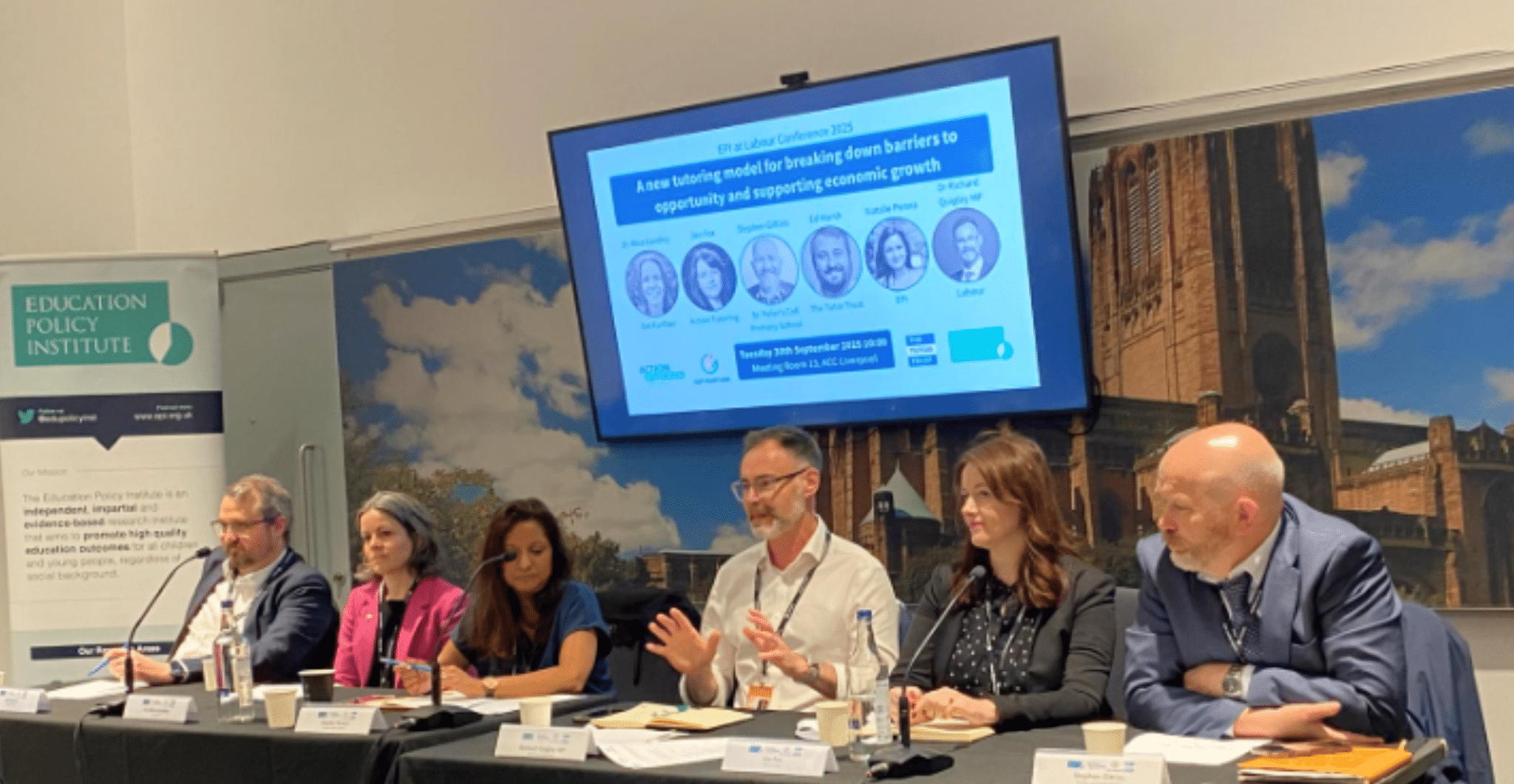
Action Tutoring partnered with the Education Policy Institute, Get Further and Tutor Trust and Richard Quigley, MP for the Isle of Wight, at the event in Liverpool on Tuesday, 30th September, where they held a panel on ‘a new tutoring model for breaking down barriers to opportunity and supporting economic growth’. Powerful testimony was shared by Steve Gittins, Executive Headteacher from St Peter’s CoE in Newcastle, who has partnered with Action Tutoring for many years, having seen first hand the difference it makes to his pupils.

the Labour Party Conference with Tutor Trust CEO, Ed Marsh,
Get Further’s Dr Alice Eardley, the Education Policy Institute’s Natalie Perera,
Dr Richard Quigley, MP for the Isle of Wight, and St. Peter’s CoE Primary School’s Stephen Gittins
(executive headteacher at one of our partner schools).
Why and what now?
The topic comes amidst increasing challenges facing the UK economy and education sector, including:
- Inequality continuing to rise.
- Young people from disadvantaged backgrounds are far more likely to achieve lower grades than their peers and far less likely to progress to higher level study or sustained employment.
Tutoring is one of the most effective interventions for addressing these challenges by closing the attainment gap for under-resourced young people. But following the end of funding through the National Tutoring Programme and 16-19 Tuition Fund income in 2024, schools have struggled to access it. This means pupils facing disadvantage are falling further behind their non-disadvantaged peers, including within GCSE maths and English.
With the national attainment gap significantly wider now than at any time in the last 12 years, policymakers, school leaders and education experts are collaborating to address what a purposeful approach to tutoring can look like.

Labour Party Conference in Liverpool.
Action Tutoring CEO, Jen Fox, said: “I’m delighted to have had the opportunity to attend the Labour Party Conference and discuss the transformational impact tutoring can have on those facing disadvantage. With our fantastic partners at the Education Policy Institute, Get Further and Tutor Trust, we have outlined how integral a role tutoring can play in growing the economy alongside increasing equity in our education system.
“As highlighted by evidence from the Education Endowment Foundation, tutoring continues to be a key intervention in helping to narrow the attainment gap and in reaching disengaged young people.
“We believe that by adopting a state-funded tutoring model, this can help achieve the Labour Government’s ambitions of sustainable and strategic change, growth, and delivery of its five missions for Britain, including within education, by breaking down the barriers for opportunity at every stage.”
Tutoring’s economic benefits
And the argument for state-funded tutoring isn’t just a social justice issue; the benefits to the economy are clear. In a 2024 paper, Public First calculated that for every £1 spent on tutoring, £6.58 is returned to the economy. In a climate where economic growth is everything that a Labour Government is chasing, investing in tutoring seems like the closest you get to a sound investment.