
Why I give my time to volunteer with Action Tutoring- Giving Tuesday
3 December 2019
The questions on the sheet blurred as tears of frustration rose in my eyes and I struggled to grasp the concepts needed to work out the answers. I was twelve years old and failing to understand how to work with negative numbers. Luckily, my maths teacher, realising I needed help with maths in general, had offered to let me stay after school to do some extra work.
“Okay, come stand over here,” he said. “This is zero. Now take three steps forward and you are at positive three. Now walk backwards (subtract) four steps – how far are you behind the point of zero? Now if you were to add negative steps, would you go forwards or backwards?”
When the inevitable lightbulb moment occurred, and I finally ‘got it’, the feeling when I knew I could grasp these difficult and new ideas was wonderful. It was like I had been given an incredible gift.
Originally, I wanted to give my time to volunteer with Action Tutoring because I wanted to contribute to society outside of work and was reading more and more about how inequality causes a large attainment gap between young people, which seems incredibly unfair. As a first-generation university student from a working-class background I have some insights as to how difficult it can be to achieve your best at school, especially when there are other external pressures that teachers may not be fully aware of or are unable to do anything about.
But, since I started volunteering with Action Tutoring, I now understand that this gift of learning is something that is bestowed on both the receiver of knowledge and the giver. It is incredibly rewarding to help the pupils learn new things and improve their skills, and their enthusiasm always makes me come away inspired for the week. It even inspired me to run a 10K to raise funds – something that I certainly found a challenge but helped me to strive towards a new achievement, something that the pupils are doing each and every day. The students are running mental 10Ks every day through their learning, and their teachers and tutors are the pacemakers.
I can’t recommend working with Action Tutoring enough – you get incredible support; the volunteer coordinators are so friendly and will bend over backwards to help you become a great tutor, and the students will teach you things about yourself you never even thought to ask for.
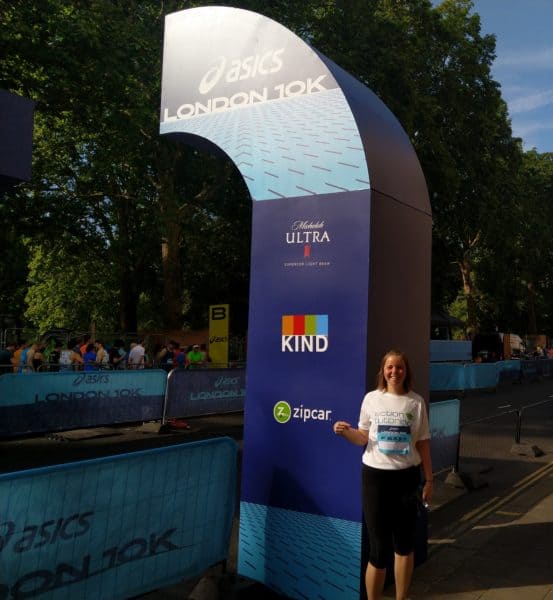
Elaine, after running the ASICS 10k to raise money for Action Tutoring
Jo’s education podcast digest (episode 2)
22 November 2019
The last time I blogged, I shared my top learnings from education podcasts. I’ve carried on listening to episodes of my favourites since then, and wanted to share a few new ideas and points to ponder. Although, I’ll admit that I’m a little behind with some of them.*
- Working memory is a bit like a Post-it, from Trialled and Tested: Working Memory
Working memory can be a tricky concept to get your head around at first. But this simple and apt analogy from cognitive psychologist Dr Tracy Alloway is the best I’ve heard yet. Why? Well, as she outlines in the podcast, Post-its are:
- pretty small – there’s no chance of fitting all of GCSE History onto a Post-it, and your working memory couldn’t handle it all at once either.
- come in different sizes – not everyone’s working memory capacity is the same, and it tends to increase during childhood.
- usually a temporary way of keeping track of information – you wouldn’t rely on a Post-it to remember something long-term, and working memory is similarly shortsighted.
I also love the idea of working out the size of your working memory by using the “backward digit test”. When tutoring, thinking about working memory reminds me to make steps explicit, use checklists, prompts or worked examples, so they can save the precious space on their working memory post-it for practicing whichever skill we’re working on.
- Does slang have a place in the classroom? From Tes Podagogy S7 E6: Slang and standard English with Rob Drummond
Ever been unsure about how to respond to pupils using dialect or slang within tutoring sessions? This podcast shows you’re not alone. Although – kudos to you if you always understand all of the slang they use (I’ve often been flummoxed)! Before I say any more, I think I should come clean and recognise the irony of writing this as a born-and-bred Geordie who allowed the accent and dialect to be ironed out of me whilst at university elsewhere…
Ok, onto the episode, which carefully explores the messages we send when celebrating or denigrating slang and regional dialects, the elusive ‘standard English’ or value-laden ‘received pronunciation’. A couple of choice soundbites from this episode can act as great guides: recognise that pupils need to be able to function in “different linguistic worlds” (for example, the linguistic worlds of home, friends, hobbies or sports they play, as well as linguistic worlds of the different subjects they study, and eventually the workplace). Each is unique and worthy, but linguistic practices may or may not travel well between worlds. Secondly, we should “celebrate linguistic diversity”: slang and dialect are brilliant ways to express ourselves, and standard English or received pronunciation have their place too. This is a topic to think about and reflect upon deeply and over time, and I found Rob’s points carefully thought out and informative.
- How valuable multiple-choice questions can be, from Inside Exams S1 E7: Guessing your way into dentistry?
Many of our pupils will encounter multiple-choice questions in their assessments: primary pupils sitting SATs, secondary maths pupils sitting their GCSE with AQA, and that’s before considering the range of other subjects they study. Plus, if you’ve used our initial secondary maths workbook, or taken a look at the website diagnostic questions, you’ll have seen some carefully-designed multiple-choice questions. They are a great way to plan for tutoring as each wrong answer has been chosen to represent a particular misconception or error in a pupil’s thought processes – meaning you can be proactive about how you might respond to a pupil getting the answer wrong.
In this podcast, the ever-informative Mr Barton discusses MCQs with Zeek Sweiry, a Senior Researcher at AQA. There’s plenty of myth-busting in this succinct episode, but my favourite phrase was the idea of the wrong answers as “really plausible distractors” – I’ll be forever imagining them as excitable cartoon characters jumping about trying to tempt pupils into picking them! Thinking this way reminds me to aim for pupils deeply understanding the content we’ve covered in tutoring, to give them the strength of mind to discount and ignore plausible distractors, despite their pleas or cute appearance. The other really interesting myth discussed was whether pupils just guess. I loved the point that MCQs are pretty intriguing puzzles even if you don’t know the content – many of us would have a go at a MCQ on a topic we know nothing about, by using deductions and trying to rule certain options out. So, if you’ve ever been a bit skeptical about how useful MCQs can be for learning, or want to know why MCQs are used in exams, this episode is well worth a listen.
*I blame my discovery of TV-related podcasts for this – they’ve competed for my listening attention recently. Anyone for Obsessed with…, Dustbusters or Shrine podcasts? If you enjoy episode-by-episode dissections, outlandish fan theories, and interviews with the professionals behind the latest TV dramas, they are definitely for you!
Imagine you’re Gavin Williamson, how would you “Do Good Better?”
18 October 2019
Suppose you’re Gavin Williamson right now.
Get into character, you are Secretary of State for Education (at time of writing), MP for South Staffordshire (at time of writing), you (allegedly) once owned a tarantula that you kept on your desk and are (allegedly) a big fan of the original UK House of Cards series. We’re going to concentrate on the first of these facts. What do you do with the power you wield? There are any number of things you have responsibility for, including:
- early years.
- children’s social care.
- teachers’ pay.
- the school curriculum.
- school improvement.
- academies and free schools.
- further education.
- apprenticeships and skills.
- higher education.
So, where to start? Holding the position of Secretary of State for Education (or equivalent roles, as the name and exact responsibilities have varied over the years) can be seen as a place to make your name in politics. It has been held by a number of heavy weights (politically), including Ken Clarke, David Blunkett, Shirley Williams and who could forget Margaret Hilda Thatcher? If you want to delve into more detail on previous politicians who have held the post, I would recommend the excellent website: https://greatedusecs.com/ curated by Laura Mcinerney.
I was only a secondary maths teacher for a few years and yet, thanks to Michael Gove, managed to experience a fair amount of change in the curriculum. This year we have had a new Ofsted Inspection Framework launched and party conferences are full of promises on how to improve education, including a policy from Labour which would abolish Ofsted.
As part of my role involves creating the resources and training for Action Tutoring I know from first hand experience the temptation to continually make changes and tweak things. I have hundreds of ideas of my own and then when you open it up to our team and tutors we could probably collate over a thousand suggestions of things to change. With so many things to change, we’d better get started!
But wait.
Hold on a minute…
Are these changes always good?
Are these changes all effective?
Do these changes make a difference in what we’re really trying to achieve or do they just keep us busy and look good on the surface?
If you haven’t heard of Effective Altruism or the book Doing Good Better, I want you to go away and look at least one of them up right now. Go on, I’ll wait…
Back? Good, I told you I would wait, didn’t I?
I first read Doing Good Better in June 2018 in Uganda. I then re-read it when visiting Ghana in November that year (I promise these holidays are the exception not the rule, I’m usually found in Bristol or London working very hard). Ironically, I gave my copy away when I was in Ghana last year and had to buy another. I would really recommend you reading it too… here… have my copy.
Here is a brief introduction to the book from https://www.effectivealtruism.org/doing-good-better/
Do you care about making the world a better place? Perhaps you buy ethical products, donate to charity or volunteer your time in the name of doing good. But how often do you know what impact you really have?
William MacAskill, Research Fellow at Cambridge University, has spent the last five years developing the philosophy of effective altruism, which applies data and scientific reasoning to the normally sentimental world of doing good. In the course of his research he’s come to the remarkable conclusion that most ways of making a difference achieve little, but that, by targeting our efforts on the most effective causes, we each have an enormous power to make the world a better place.
Such was the impact that reading the book has had on me, I managed to persuade the team at Action Tutoring to make it our theme and focus for the year.
Part of the reason for this is that over the last year, I’ve become more involved in working on our impact planning. This has been a mix of carrying out a piece of work on quality assurance, working with The Centre for Education and Youth (formly LKMco) and attending Impact Forums with other charities, run by our funder Impetus.
One of the outcomes of this is working with our Data and Evaluation Manager to come up with an Impact Improvement Strategy for Action Tutoring. I already know this piece of work isn’t perfect, but it’s a step towards being more effective and having the biggest impact with the resources we have.
Hold on, Gav! Gav! Pssst, that’s you… you’re Gavin Williamson, remember?
What are you going to do to have the biggest impact on education in this country?
If you’re still not sure, one suggestion that piqued my interest this week was from Becky Allen https://rebeccaallen.co.uk/2019/09/29/the-ungameable-game/
It ties into some of the ideas that Doing Good Better raises. Whatever activities we’re doing, we will almost certainly change how we carry them out by how those activities are judged. To ensure we’re having the biggest impact we can, maybe we shouldn’t focus only on the activities we’re doing, but what and how we’re really trying to measure at the end of the process.
Or if we’re more interested in our personal ‘success’ we could all get tarantulas for our desks and rewatch House of Cards to pick up tips from Francis Urquhart on how to make our way to the top.
World Mental Health Day- The importance of staff wellbeing
10 October 2019
World Mental Health Day is a day for global mental health education, awareness and advocacy against social stigma. This year it will be held on 10th October 2019 and we will definitely be marking it as an organisation to boost the conversation on mental health. At Action Tutoring we have been doing a lot of work over the past year to increase focus on staff wellbeing and positive mental health. So many of us have been affected by mental health – according to the World Health Organisation, one in four people in the world will be affected by mental or neurological disorders at some point in their lives. This is not something any organisation can or should ignore.
To me, it makes so much sense to prioritise the wellbeing of our staff. Healthy staff will perform better in their roles, have positive relationships at work, take fewer sick days, stay in the organisation longer and be much more engaged and motivated. But most of all, I want Action Tutoring to be a good, considerate employer that looks after our staff well. According to this book we spend around 80,000 hours at work, and this time can have a huge effect on our wellbeing. If our workplaces don’t prioritise our mental wellbeing, that can have big consequences.
According to Mental Health First Aid (MHFA):
- Stress, anxiety and depression are the biggest cause of sickness absence in our society.
- Mental ill health is responsible for 91 million working days lost every year.
- Mental ill health costs UK employers £34.9 billion each year
Over the past year, there are a few ways we have tried to improve our staff wellbeing. These include:
- We have had an Employee Assistance programme in place for a few years however usage has historically been low. We have promoted this much more this year and have seen usage increase. One way that has particularly helped is through people openly talking about their experiences using the service and breaking down any taboos of accessing counselling or other support.
- We have trained two Mental Health First Aiders who, as well as being a safe person for employees to speak to if they are struggling, are also taking a lead on improving our communications and openness around mental health.
- We have introduced ‘Headspace for Work’, offering a subscription to the meditation app to staff, to help support their wellbeing. Research has shown 30 days of Headspace use lowers stress by 32%, and just 4 sessions reduces burnout by 14%.
- We have included staff wellbeing sessions at team away days, on weekly email bulletins, team meetings and as part of our induction process. We use these to promote what services are on offer, share tips for positive wellbeing and personal experiences.
- We have introduced a Staff Wellbeing Guide which includes a summary of all services on offer through Action Tutoring, some tips and advice for supporting our own wellbeing as well as those around us and links to local external services for all of our staff around the country
If you are interested in changing your workplace wellbeing culture, there are many places to go for free resources and advice. Mind, MHFA, Time to Change are just a few. I am so pleased with the impact this has had on our team and the feedback we have received, there are so many benefits and you will have a happier, healthier workforce as a result.
Collective Sustainability – Quality education
3 October 2019
This article is part of a series to explore how everyday citizens can support the Sustainable Development Goals (SDGs) locally through the power of collective action.
Education for my sister and all!
This article will be a bit more personal than all the others for one simple reason: if I needed to pick only one SDG to support for the rest of my life, education would be it. As they say, if you want to find your passion, you do not need to look for it, it is already there in one form or another. Probably my younger sister could tell you even more about this, accompanied with some rolling eyes, as she was the guinea pig of my early teaching attempts. It was obvious which books I was trying to use to teach her, their first few pages were full of writing and crinkles, the rest pristine, as eventually she always went on strike. I had to convince her again and again, “just one more class, it will be fun, I promise!”
Jumping forward in time eventually teaching did come back into my life, not as a full time career but, through an initiative I started with my friends to teach presentation skills to children. I absolutely loved teaching, it was the highlight of my week. As soon as I left the classroom I started thinking of new ideas to make sure the children understood the concepts and enjoyed the class at the same time. I currently work for an online education company, with which I can indirectly contribute to the lifelong learning of thousands of people around the world!
Getting back to the roots
When I moved to London I left our initiative behind. Despite my job in education, I did miss hands-on teaching. My favourite subject at school was maths. I truly enjoyed those extra exercises and brainteasers, so it was quite an obvious idea to give the love of maths to others (‘cringe-factor’ 10 out of 10!). After a quick Google search I stumbled upon Action Tutoring, which is one of the largest education charities offering volunteer tutoring opportunities in the UK. They specialise in helping pupils who are from disadvantaged backgrounds and struggle with English and maths, but could not afford to pay for extra support.
After my induction training I found myself standing sleepily at 8am at the gates of a primary school at King’s Cross, with ten other volunteers. Initially, I thought that the hard bit would be to make up the exercises and cover the whole curriculum. This is not the case though, as Action Tutoring provides a top-notch exercise book, with some really engaging exercises and games. The more challenging bit is motivating your pupils. I mean for one thing I am not a morning person, but imagine the enthusiasm the pupils have at 8am for two subjects they are struggling in. However, the mood always lifted by 9.30am and the pupils leaving with a smile on their faces.
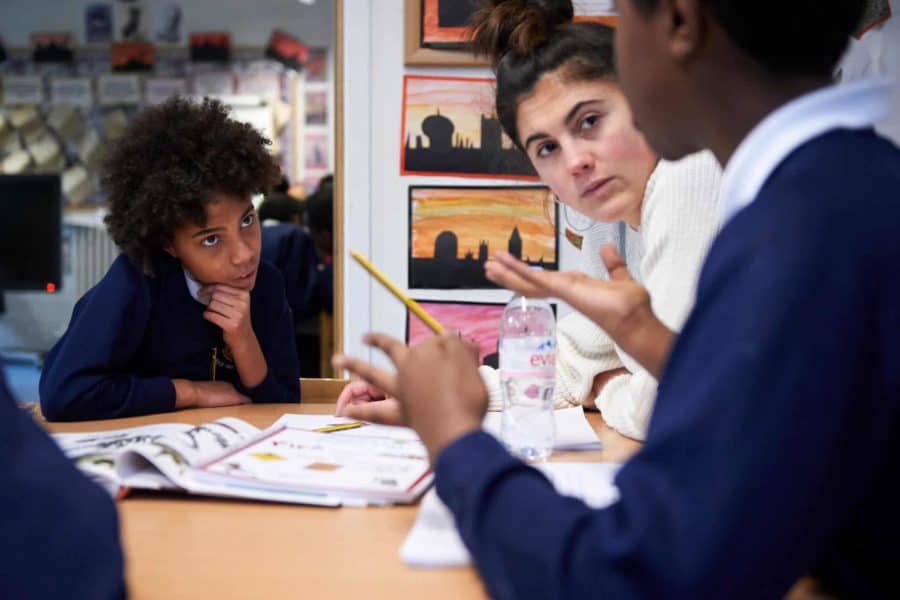
Maths – not an all-time favourite?
Especially not fractions. I broke out in sweats several times, trying to find a way to explain the topic so that it finally clicked. First, you try to describe it as you remember it from when you were 11. You draw a big apple pie and ask them to colour the slices in, “You see, 1/4 is the same size as 2/8. Easy!” Blank looks. Right, so they don’t like apple pies, that must be the issue, let’s try with pizza. Same look, this time with eyes wandering to the window. Oh no, oh no, I am losing him! Do something! Am I explaining it wrong? No this can’t be, I tried the apple pie AND the pizza! Clearly, he is a lost cause, maybe we should just practise converting grams to kilograms. No, come on, one last time.
And then you hear an “Aaaaaaaahhh”, which usually comes with a smile. A word that is so genuine that no one can fake it and it means that you can finally relax and breathe. Your job done for the day. With one of my pupils I had to wait for this moment for several weeks, and in those sessions she was yawning more than the number of exercises we solved. And then one day, she turned to me and said: “You know what? I don’t hate maths anymore, I actually like it now!”
Education in numbers
Just as we have seen with health and wellbeing, social disadvantage plays an important role when it comes to education outcomes as well. Already at a young age it affects school attainment as, on average, disadvantaged children are four months behind at the age of five, nine months behind by age 11, and 18 months behind by 16 years of age in England1. Later on, the scissor does not get narrower, as in 2018 only 20% of 18 year olds from the most disadvantaged areas entered full time Higher Education, which is higher than ten years ago. This figure for the most advantageous areas was 47%2. This is why initiatives like Action Tutoring are key to help these young people to fall behind with their education.
How could you get involved?
Action Tutoring runs its programmes in school terms, and you can join them for any term during the school year. They work in over 80 schools in London and another seven cities around the UK. A full-time job is not an issue as you can tutor just before work, to start your day on a high note!
1 Education in England Annual Report
The value of open-ended questions
13 September 2019
September has rolled around again and it’s the start of another academic year. If you’re completely new to volunteering with Action Tutoring, you’ve probably started wondering how you’ll connect with your pupils during sessions.
Some questions you may have as a tutor:
- How will I help my pupils reflect on their learning?
- How will I extend their thinking?
- How will I encourage them to share their thoughts?
- How will I support my pupils to draw connections?
I know that I spent a great deal of time turning over questions such as these while I was completing my teacher training course. The answer? Open-ended questioning.
Why are open-ended questions important?
Effective questioning can challenge pupils and provide the adult with an insight into how they think and process information. An open-ended question offers a range of responses, rather than having a prescriptive set of answers.
An example of an open-ended question versus a closed question:
- What did this character say?
- Why do you think this character said that?
At first, asking open-ended questions might seem a little contrived and awkward. For many of us, our default is to ask closed questions, which seem to occur to us more naturally. Closed questions also seem to provide an easy shortcut to assessing pupil learning. The pupil’s answer is either right or wrong, which can indicate whether the pupil has understood the content.
However, this is not the whole story. Closed questions do not require the same level of cognitive challenge as open-ended questions, which provide scope for personal interpretation and shades of opinion. Open-ended questions also provide an opportunity for pupils to engage in higher order-thinking, by giving them the chance to reason, reflect and analyse.
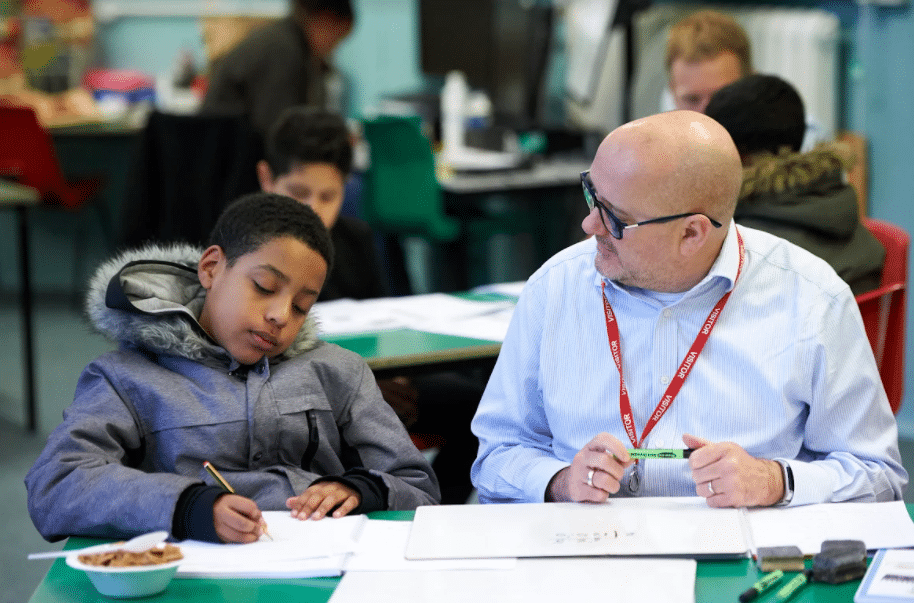
What are some ideas for some effective open-ended question sentence starters?
- What do you think…?
- How might you decide…?
- Why do you think…?
- How do you feel about…?
- Why might someone disagree…?
- How did you come to this conclusion…?
With a bit of practice, you’ll quickly learn how to master open-ended questioning.
How does that prospect make you feel?
If you would like to gain tutoring experience, enhance your skills and help disadvantaged pupils receive the academic support they need, get involved with Action Tutoring.
GCSE Results Day – celebrating our pupils’ successes
30 August 2019
It has been a week since GCSE Results Day and we would like to reflect on the successes of our brilliant pupils and volunteers.
GCSE Results Day is an incredibly important date in Action Tutoring’s calendar and we were out and about in our partner schools to celebrate in the successes of our 2019 Year 11 pupils.
There were some really fantastic achievements we heard about on the day and wanted to share them here. As a charity we focus on supporting pupils who, at the start of the year, are at risk of not achieving a grade 4 in these crucial exams…
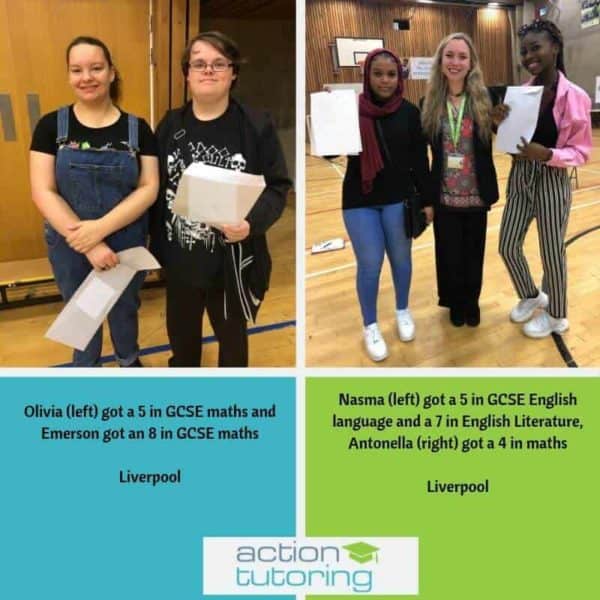
Nilam, a pupil who attended one of our maths programmes in London, got a 5 in maths and said, “Action Tutoring really helped me. Now I can go to sixth form and do the A Levels I want”. Maya, who participated in one of our English programmes got a 6 and commented, “Thank you for teaching us everything and helping us to get our results. I would definitely recommend you to the girls in Year 10”.
We shared numerous posts on our social media throughout the day of the happy faces of our pupils after receiving their results. Our Programme Coordinator for Liverpool, Hannah, got some lovely photos of pupils in Liverpool who were incredibly happy with their grades.

We received some really positive feedback on how our fantastic volunteer tutors have supported them: “Both my tutors helped me a lot. In September I’m going to college to do Health and Social Care and I want to be a midwife.” Another pupil said, “I would like to thank you so much for helping me in maths. I’ve never felt more understood and listened to. Your methods really helped.”
We are thrilled with our pupils’ results this year and would like to thank all of our volunteer tutors for all their hard work in supporting our charity. The autumn term is fast approaching and we are looking forward to working with more pupils and volunteers in the coming months. We still have lots of spaces left to help out, so do get in touch if you’re interested. We are also very excited to be launching in Nottingham this term and expanding our reach further.
If you would like to get involved, simply complete our short online application form to become a volunteer tutor with us today. Help young people achieve and reach their potential in English and maths.

Zayn’s thoughts on starting secondary school
16 August 2019
This September, thousands of 11-year-olds across the UK will be making the exciting and nerve-racking jump to secondary school. In the coming weeks, they will flood into town with their families to pick out their new uniforms and update their pencil cases in preparation for the next milestone in their lives.
However, the transition to secondary school can be overwhelming. In fact, disadvantaged pupils are at risk of falling behind their more affluent peers by two months per year over the course of secondary school (Education Policy Institute, 2017).
Although the Year 6 pupils we have worked with at Action Tutoring have performed brilliantly in their SATs exams, I cannot help but wonder how they will settle into their new schools.
To gain more of an insight into how they might be feeling, I sat down with my nephew, Zayn (age 11), to ask him a few questions:
How do you feel about starting secondary school?
I’m feeling nervous but excited. When I started primary school I was the youngest but moved on to Year 6 and became the oldest. When I go to Year 7 I will be the youngest again… But I am kind of happy to get a sense of independence.
What do you feel nervous about?
The school is so big and it will be hard to find the different classes.
What has helped you to feel prepared for secondary school?
1) Tutoring – my mum has signed me up for physics tutoring and I really enjoy it.
2) My school had an assembly where secondary school teachers came in and told us about what it will be like and how to stay calm.
3) I spent a day at my new school and that helped me.

Zayn says goodbye to his friends after 7 years at Primary School
If you had three wishes for secondary school, what would they be?
1) Stick with my friends who are coming to the same school as me.
2) Try more subjects like history and get better at them.
3) To play for the school football team so that I can play against different teams
… Oh and I don’t want to get detention because it is going to be long!

Zayn (centre) and family enjoying the summer holidays
Through our volunteer tutoring we have an amazing opportunity to help pupils feel heard and supported by being mindful of what it feels like to be in their shoes. We can share our own experiences, build their confidence and encourage them to try their best to develop!
In praise of podcasts: five things I learnt about education from podcasts
9 August 2019
Rewind to the late 2000s. I’d received a really cool mp3 player for Christmas, shaped like a jelly bean but made out of glimmering pearl-like plastic. It provided perfect entertainment for commuting. Until one day it squirmed its way out of my hand, executing a perfect somersault, and plummeted directly through the gap between the train and the platform edge. Panicked, I listened to it clunk against the rails, followed swiftly by warning tones that the doors were about to close and so jumped off the train impulsively, a little lost without the entertainment I’d been relying upon!
Thankfully I’ve not repeated this escapade with my current entertainment device – old habits die hard though, and I’ve still picked a similar glimmering white colour scheme from the many options available. Anyway, what was the reason for me sharing this whistle-stop tour of recent audio technology? For many of us, all sorts of tasks (commuting included), are now accompanied by our own choice of entertainment, plugged straight into our ears. Instead of noughties pop my companion is often a podcast and there are plenty on education that are both interesting and informative. Here are five things I learnt about education from podcasts:
- Homework and class sizes appear to influence pupils’ outcomes less than we think.
from BBC The Educators – John Hattie
This podcast interviews a number of big thinkers in education, and is well worth a listen. This particular episode with John Hattie includes some information about his meta-analysis of education research and how it can help us understand what might, and might not, make a difference to pupil outcomes. As I learnt at a recent event, there is a tension in meta-analytical work between the quantity and quality of studies to include – although more studies might initially seem better, this isn’t necessarily the case if they are not equally high-quality and ‘translatable’ to new and differing contexts. All the same, the work of the Education Endowment Foundation also shows that homework and class sizes might not be as significant as we might think.
- It usually takes examiners 18 months to craft an exam paper!
From Inside exams – 1. Talking my language
It would be easy to ignore what routes test papers go through before they arrive on exam desks in the summer term. This podcast walks us through some of the processes involved in creating, reviewing and checking exam papers. A great way to learn more about exams, direct from the examinations boards themselves.
- How wide the gap is between pupils’ everyday talk and the academic vocabulary they need to succeed in school, as well as how to bridge this gap. From Mr Barton podcast – Alex Quigley: Closing the vocabulary gap
Everyone is a teacher of language and this is a really interesting topic for both maths and English tutors – as well as any prospective teachers of other subjects. Alex Quigley is a former English teacher and now works at the Education Endowment Foundation.
- Why number lines make more sense vertically than horizontally, and how the language of ‘opposites’ can be useful in teaching negative numbers
From Mr Barton podcast – Bernie Westacott
Mr Barton is basically education podcast royalty. He’s interviewed many influential figures for the podcast, which is regularly listened to and discussed by the most maths-phobic teachers. You know when Mr Barton likes something because he says, “that’s flippin’ brilliant” and he says that a lot in this podcast, which is available to listen to as well as to watch. It gives some great context to what pupils will have experienced early on in primary school as well as great tips for teaching negative numbers. I’m a big fan of vertical number lines since watching this. Why? They link to real-life examples (think thermometers and lifts) and the higher up a number is, the bigger it is. With a horizontal line, you lose these clear links and in their place it all becomes more ambiguous for pupils.
- Why it’s desirable that pupils find things difficult, and the importance of ‘wait time’ after we ask questions.
From Evidence based education – Robert & Elizabeth Bjork
The Bjorks are incredibly knowledgeable and influential researchers on learning and memory. This is the sort of podcast that really makes you think about how complex learning is, and helps question the assumptions we’ve picked up along the way. It’s worth a listen to understand that when pupils find tasks hard, it might not actually be having a negative impact on their learning. For a quick written summary, I’d recommend this article. ‘Wait time’ is all about how much silence we leave, after asking a pupil a question. Often, it’s tempting to break the silence and either answer the question ourselves or rephrase it. Both approaches might result in pupils not having the time they need to think deeply about the question and formulate a response. Plus, we are tacitly telling them they don’t always need to think about the questions we pose – as we might answer them ourselves! If you want to know more about their research you can also listen to their interview on Mr Barton’s podcast and their YouTube channel.
More education podcasts I’ve enjoyed:
BBC more or less – delves deep into statistics (often sent in by the audience) and provides great examples of mathematical ‘answers’ that aren’t always simple and can be controversial or used as a starting point for debate.
TES – the education podcast – TES news is great for what’s going on in schools, and TES ‘pod-agogy’ (yes, I love that pun!) for teaching tips.
The Dysadvantage podcast – experiences of people with dyslexia: exploring how they cope with the challenges it poses and the advantages they feel it brings.
TED Talks education – more global and wide-ranging in topics, great if you want a broader view of education beyond tutoring and the UK system.
The NCETM Maths podcast – aimed at maths teachers, but there are some great episodes on the maths mastery approach and interviews with maths teachers.
Trialled and tested – a collaboration between the Education Endowment Foundation and Evidence Based Education, discussing key pieces of education research.
What I’m listening to next: Researcher Daniel Willingham’s keynote at a recent ResearchED. Willingham’s book ‘Why don’t students like school’ has been a big influence on me. The quote ‘memory is the residue of thought’ is a really pertinent one for anyone in education, so I’m looking forward to hearing what Willingham has to say.
The Power of Yet: How discovering Growth Mindset had an impact not only on my teaching but on my path to self-care
2 August 2019
When I first started teacher training, Carol Dweck’s research on Growth Mindset formed a central part of the training I received. I was so inspired by everything she said, especially by this quote:
“Instead of luxuriating in the power of yet, they were gripped in the tyranny of now.” (Carol Dweck, 2014)
I realised I definitely had a growth mindset professionally. I knew I was on a learning curve to becoming a teacher and I wanted to embed Growth Mindset strategies into my teaching practice. I can confidently say that I was able to do that. There was nothing more rewarding than, after a few months, hearing my pupils use these phrases with each other:
“I’ve tried really hard today.”
“I can see you’ve put in a lot of effort.”
“Wow, you didn’t give up with this tricky sound, well done!”
In my classroom and in my teaching practice, I had embedded a culture of continuous learning, growth and positivity, and I could see this in the way my pupils were starting to use my growth mindset language in their everyday life. However, in my personal life, everything was spiralling out of control.
Whilst struggling with missing my family, having no work-life balance and challenges with my mental health, I realised I was gripped in the tyranny of now, barely coping with the anxiety that was swallowing me up. I could see no way out. It was around that time that I started watching the Netflix series, Queer Eye, and was really struck by what one of the main stars of the show, Jonathan Van Ness, said:
“To me, self-care isn’t really shallow. Showing up for yourself, putting on a little moisturizer, can inspire so many different parts of your life.” (Jonathan Van Ness)
I realised I was not showing up for myself. I was not eating well, not exercising, not sleeping well, not taking time to myself, not taking care of my skin…So, after watching the episode, I bought myself a face moisturiser and a face wash. I knew that my wellbeing was not going to improve magically, and I needed to put in the effort and I could take self-care one step at a time. It might seem silly to some that a little bit of moisturiser would have such an impact on my wellbeing, but it wasn’t the moisturiser itself, it was what it represented: my first step in buying something to take care of myself. As people say, the journey of a thousand miles starts with one step.
One year on, recent steps I’ve taken to improve my wellbeing are: I joined an exercise class, I included more vegetables in my diet, I socialised more with friends…
The road to loving and taking care of yourself is long and I am not there yet, but I am luxuriating in this ‘power of yet’ and am miles further than I was this time last year, and I feel great.
Now, as Programme Coordinator at Action Tutoring, I aim to always include Growth Mindset training within the first few weeks of my programmes, hopefully inspiring tutors to use Growth Mindset techniques in their tutoring, just as Carol Dweck inspired me. This will not only have a profound impact on the pupils, but perhaps on the tutors as well.