
Action Tutoring News
Action Tutoring begins the testing phase of its online tutoring development
15 June 2020
Action Tutoring is thrilled to have begun the testing phase of its online tutoring development this week. Expanding its tutoring programme delivery to online, as well as in person, was already part of Action Tutoring’s strategic plans before the crisis hit, but the charity has now refreshed the timescales to enable it to deliver the provision much sooner.
The charity currently supports almost 3,000 disadvantaged pupils each year, however just over 78,000 disadvantaged pupils across the country do not achieve English and maths at GCSE each year and could also benefit from this support. These young people are less likely to achieve the grades they need to progress in life, but academic tutoring can help them to do this. Action Tutoring has already developed an impactful face-to-face tutoring model. By expanding its provision to be delivered online, it can ensure many more young people, outside of the cities where it currently operates, can benefit from its support. The current pandemic has prompted Action Tutoring to accelerate the development of its online delivery, so that pupils can be supported as soon as possible even while social distancing rules are still in place.
Susannah Hardyman, CEO and founder of the charity, said: “We are delighted to be ready to test our online delivery. The team has worked exceptionally hard to get to this point, in such a short timeframe. This is an essential new offering for our charity, enabling us to bring tutoring support to even more disadvantaged young people across the country at a time when it is so needed.”
Action Tutoring will be using this test period as a learning and preparation phase to ensure it is ready to roll out online tutoring more widely in the autumn. The charity has engaged six primary and secondary schools to work with over the testing period, across three different cities. With support from over 60 of its existing inspiring volunteer tutors, up to 86 Year 6 and Year 10 pupils will be able to receive online tutoring over a five-week period.
Pupils will be set up on computers in their schools or at home and receive tutoring from volunteers who are located anywhere across the country. Tutors will be able to support up to two pupils at a time and the sessions will be delivered using the Vedamo online platform. Action Tutoring has invested in this diverse online platform which has fantastic functionality, meaning the provision will be as close to face-to-face delivery as possible. Action Tutoring has already developed a suite of tutoring workbooks, for its pupils and tutors, to cover relevant maths and English topics. These will be uploaded onto the platform for the tutors and pupils to use.
This structure was decided to help mirror the charity’s face-to-face delivery as closely as possible. By having the pupils located together, in school, it can ensure there are teachers and other staff members present to support with any issues and monitor the quality of the tutoring being delivered in a learning environment. It also helps the pupils to feel supported and not isolated when receiving the help. In the short term this delivery approach also allows tutoring to continue while external volunteers are prevented from entering the schools due to social distancing restrictions. Action Tutoring will be providing noise-cancelling headphones and graphics sheets (maths-specific) for pupils participating.
Action Tutoring will also be testing ‘at home’ tutoring with one of the participating schools. Although the charity’s long-term aim is for pupils to all receive tutoring at school, by testing the product with pupils at home it ensures delivery can be adapted should the external situation force this.
Action Tutoring is incredibly grateful to its six partner schools who have agreed to participate in the test phaset:
Pakeman Primary School – London
Bedminster Down Secondary School – Bristol (home-tutoring)
Seaford Secondary School – Sussex
Arts and Media School Islington – London
Queensbridge Primary School – London
Prendergast School Secondary – London
Their support and patience will enable the charity to rigorously test its new platform and delivery methods to ensure it is fit for purpose in the autumn.
“We have been delighted with the impact Action Tutoring has had on the progress of our Key Stage 4 pupils. We saw a marked increase in confidence and engagement from those pupils who attended the sessions. The support of tutors in a small-group setting has proved invaluable to our young people. We are therefore excited to be participating in Action Tutoring’s new pilot. This will ensure pupils will be able to get support during this time of remote learning.” Susan Service, Headteacher, Arts and Media School Islington, London
Action Tutoring would not have been able to start this development without the financial support from generous public donations and fundraising efforts and some crucial contributions from other funders including: UBS, Wellington Management Foundation, The Fore and Nesta. It is incredibly grateful for these offerings, particularly given the current economic pressures on organisations and society.
“At UBS we recognise the difference that skills-sharing can make in overcoming disadvantage. That’s why we’ve supported Action Tutoring in their growth across London. We’re proud to support an organisation which strongly believes that no child’s future should be limited by their background, and which has developed a powerful programme to do something about it. Sadly the issue looks set to be exacerbated by the consequences of the global pandemic. We’re pleased that our grant will go towards ensuring that young people who need it most will continue to receive support through Action Tutoring’s new online offering.”
The charity is incredibly grateful for the inspiring volunteers who have generously given their time to support this pilot and to its passionate and dedicated staff team who have committed to delivering it. The charity would also like to thank Impetus, the Access Project and the other organisations and charities who have contributed through their advice and guidance in the development phase.
“I am delighted to be involved in Action Tutoring’s online tutoring test phase because it is an opportunity to try to remedy in a small way the damage done to children’s education by the COVID-19 school closures and also, if successful, in the longer term it could allow Action Tutoring to support many more disadvantaged pupils. Preparing for tutoring has been a learning experience for me – it turns out that writing fractions on a virtual whiteboard is a lot trickier than on paper!” Sarah, Action Tutoring tutor, London
This forms part of a wider pilot run by the Education Endowment Foundation (EEF), Sutton Trust, Impetus and Nesta which is engaging four organisations, and their different online delivery models, to assess the potential for online catch-up tuition to mitigate against the impact of school closures on the attainment gap. The outcomes from all four of these provisions will be independently evaluated by NatCen.
Action Tutoring will spend the summer months implementing its learnings from the testing phase and ensuring the platform is ready to launch, alongside its face-to-face delivery option, in the autumn. It is keen to recruit as many volunteers as possible for both online and in-person delivery, to be ready for September, so that as many pupils as possible can benefit from tutoring support and together we can help make up for the time they have lost.
To apply to join Action Tutoring as a volunteer tutor (either face to face or online), simply complete this short application form: www.tfaforms.com/332860
#BlackLivesMatter: Our statement
4 June 2020
Black lives matter.
We stand in solidarity and support with our Black colleagues, Black teaching partners, Black volunteers, Black pupils and the whole Black Community.
We have never and will never tolerate racism. We exist to tackle inequality in education and we are committed to ensuring every child is given the same, equal and fair opportunities to succeed in life.
Like our friends @TeachFirst, we know it’s not just about achieving meaningful grades and having access to jobs, but about removing structural bias and inequality. We know that in order to make long-lasting change, we need more Black and BAME decision makers in education policy, in our volunteer community and in our staff team.
Education plays a crucial role in defeating racism and we have a duty to ensure we tackle it head on whenever we encounter it. We stand together.
Action Tutoring submits evidence to Education Select Committee
4 June 2020
In May 2020, Action Tutoring was asked by Robert Halfon MP – Chair of the House of Commons Education Select Committee – to submit evidence for the Committee’s inquiry into the impact of COVID-19 on education and children’s services.
The inquiry will look at how the outbreak of COVID-19 is affecting all aspects of the education sector and children’s social care system. It will scrutinise how the Department for Education is dealing with the situation.
It will examine the impact of decisions such as school closures and exam cancellations in both the short term and the long term, particularly for the most vulnerable children.
Susannah Hardyman, CEO and founder of Action Tutoring says, “Early research is already showing that the pandemic will impact disadvantaged pupils the hardest. It’s essential that we, and other relevant organisations, are able to put forward our evidence and knowledge from the field, so that the government can make effective decisions and take impactful actions in response. With the delivery of our recommendations, and all others put forward, we can help to minimise the negative effect this crisis will have on disadvantaged young people and help them catch up after the time lost.”
Action Tutoring believes, and evidence suggests, that disadvantaged pupils, like those supported by the charity, will be the hardest hit by the crisis. A study by the Institute for Fiscal Studies suggests that children from more affluent families are spending 30% more time on home learning than are those from poorer backgrounds. By June, they will have had more than seven full school days’ worth of extra learning. The absence of education, and other means of support at home, like private tutoring, is simply pushing them further behind.
It is vital that the government prioritises its support for disadvantaged pupils once schools reopen and protects the diverse network of services that contribute to their learning and wellbeing, including charities.
Action Tutoring provided evidence in five distinct areas and submitted five recommendations of next steps. You can read the full submission here and a summary of the recommendations below. It is also available on the UK Parliament website here.
- Provide additional funding to schools in addition to Pupil Premium funding, for catch-up programmes for disadvantaged pupils next academic year – especially those moving into secondary school, or sitting national exams in the summer. This may be required for additional years.
- Consider what adjustments need to be made to national exams next summer – especially the grade boundaries – to account for lost learning time. Disadvantaged pupils must be protected and the attainment gap should not be allowed to widen any further than a reasonable variation compared with recent years.
- Extend financial support to charities serving disadvantaged pupils so they can adapt their delivery and cope with the changing needs of schools and pupils.
- Ensure all pupils have the equipment and access to technology they need at home to support remote learning, if required again.
- Promote a national volunteering campaign, raising awareness of charities like Action Tutoring enabling pupils to catch up.
Action Tutoring joins forces in online tutoring pilot to reach disadvantaged pupils
3 June 2020
The Education Endowment Foundation (EEF) has joined forces with the Sutton Trust, Impetus and Nesta to launch a new online tuition pilot to support disadvantaged pupils as schools begin to reopen and Action Tutoring is proud to be one of the four providers taking part.
The new initiative will bring high-quality tutoring to up to 1,600 pupils in disadvantaged communities over the coming weeks, supporting schools as they re-open for more pupils.
Four different models will be tested under the pilot:
- Action Tutoring will pilot online tuition in core subjects using structured workbooks, for up to 100 pupils in Years 6 and 10, across three cities;
- MyTutor, an established online tuition platform using undergraduate tutors, will support up to 1,000 pupils in Years 10/11;
- The Access Project will support 433 students in Years 10/11 and Years 12/13 who would normally receive face-to-face tuition through a new online model; and
- Tutor Trust will adapt their small-group tuition model, and offer one-to-one online tutoring for 90 students in Years 5 and 10 across Merseyside, Greater Manchester and Leeds.
The pilot will be independently evaluated by NatCen to assess the potential for online catch-up tuition to mitigate against the impact of school closures on the attainment gap.
The launch of this new Online Tuition pilot comes as the EEF publishes the most detailed analysis to date of the likely impact of school closures on the attainment gap.
Over the past decade, the attainment gap between disadvantaged pupils and their classmates at the end of primary school is estimated to have narrowed, from 11.5 months in 2009 to 9.4 months in 2019.
However, today’s analysis finds that this progress could be undone. Following a rapid evidence review looking at the impact on the attainment gap as a result of different kinds of school closures (e.g. summer holidays, adverse weather, natural disasters) it concludes that school closures as a result of Covid-19 will widen the attainment gap between disadvantaged children and their peers, likely reversing the progress made since 2011.
Crucially though, if steps are taken, such as the Online Tuition Pilot, to support schools as they work to help pupils catch-up, the negative impact of school closures on the gap could be eased.
Action Tutoring will be using the pilot as a learning and preparation phase to ensure it is ready to roll out online tutoring more widely in the autumn. This delivery option will sit alongside the charity’s face-to-face tutoring option and will enable even more disadvantaged pupils to access the benefits of tutoring support across the country.
Reading for Pleasure
9 April 2020
We wanted to share this interesting blog from one of our team on ‘Reading for Pleasure’ which was drafted before the crisis. Reading is not only important for your own well being, but it can also help with a child’s academic attainment. During this time when schools are closed, we encourage all pupils to read as much as possible.
The importance of reading for pleasure
According to an OECD report in 2002, a child’s educational attainment can be more clearly predicted by whether they read for enjoyment than it can be by looking at their socio-economic background. This startling fact partly reflects that those from disadvantaged backgrounds will have more limited access to books, for many reasons including local library closures and lack of school funding. However, it also shows that a targeted intervention in this area can have a wide-reaching positive impact on a child’s future.
Reading ability doesn’t just impact attainment in English. A recent article in Tes referred to literacy as a “magic bullet” in education, pointing out that reading is essential for pupils to be able to understand the wider curriculum. The benefits of reading for pleasure go far beyond academic attainment. Research by The Reading Agency found that reading for enjoyment is linked to increased empathy, improved relationships with others, reductions in the symptoms of depression and dementia, and overall improved wellbeing.
So how can we encourage pupils to read for pleasure, rather than regarding it as extra homework?
One simple answer is to let them see you reading for fun. Children are easily influenced by what they see the adults in their lives doing, for better or for worse. Modelling reading for pleasure helps to create a positive mindset in which reading is seen as a leisure activity like watching TV or playing a video game, rather than as a chore.
Allowing children to freely choose their own reading material is also crucial. While pupils in a class will all be expected to read the same texts, they should be encouraged to pursue their own tastes and interests in their wider reading. This might include blog posts or articles about a topic that interests them, or less traditional formats like graphic novels. Anything that gets them reading should be encouraged, even if it’s not something you would choose to read yourself.
Action Tutoring recognises the huge importance of reading for pleasure, so ‘free reading’ activities are built into our primary English workbooks. Tutors are encouraged to spend ten minutes at the start of each session reading with their pupils in a relaxed way, without testing their comprehension of the text.

The benefits of reading for pleasure aren’t limited to children. Not only does taking time for reading set a great example for pupils, it can also boost your own wellbeing. As concerns about coronavirus spread and many of us are starting to feel cooped up at home, there is no better time to lose yourself in a good book.
If you would like to encourage disadvantaged pupils to read more, you can join our community of inspiring volunteers. Your contribution is incredibly important in lowering the attainment gap and making sure all children are given the academic support they need to succeed in school.
COVID-19 set to further widen attainment gap between the UK’s 28% of disadvantaged children and their more affluent counterparts in state education warns charity CEO
2 April 2020

Susannah Hardyman, CEO of education charity Action Tutoring discusses COVID-19 and the impact of school closures on children from less well-off backgrounds.
March 2020 marked a seismic shift in education, with schools nationwide closing their doors to all but the children of key workers and the most vulnerable, whilst grappling to implement online solutions in a bid to provide effective teaching and learning to pupils. The shift also prompted unprecedented demand from affluent parents for private tutoring – an industry with an annual income of over £2bn – keen to shield with online support their children from spring/summer learning loss.
But what about the 28% of pupils in state education deemed as disadvantaged – pupils who may not have access to high bandwidth broadband to facilitate remote learning and likely won’t have space to work in which to work easily in cramped accommodation. Currently every year 75,000 disadvantaged children leave school without basic qualifications in English and maths. Pupils from disadvantaged backgrounds are not less academically able, but lack of access to tools and resources means currently only 41% of this group pass English and maths GCSEs, compared to 69% of all other pupils.
Motivation is also set to prove a challenge. We all know that it is far easier to engage with a pupil in person than it is to motivate them to work online, especially if their parents are not available to support and encourage them or that child is struggling academically. Forcing attendance of online sessions will, I believe, be highly difficult to enforce or even encourage.
Sadly, it seems inevitable that the current national crisis will further widen the attainment gap. While many schools are doing all they can now to mitigate this, and are proving themselves in so many ways as the fourth emergency service, disadvantaged children are going to need more support than ever before to catch up in the months to come. That support will no doubt need to take many forms, but tutoring is a well known, effective intervention that can play a big role in raising attainment.
As a key provider of school-based intervention programmes incorporating tutoring solutions provided free to disadvantaged pupils, Action Tutoring is calling on the government to provide catch up funding for disadvantaged pupils once schools are back to normal business in addition to the Pupil Premium funding. This could enable schools to provide extra support such as additional tuition for disadvantaged pupils – who are already 18 months behind their more affluent counterparts by the end of secondary schools – to help prevent them from falling even further behind. In the short term, Action Tutoring, along with other organisations, are lobbying the Department for Education to provide laptops and broadband access to those that need it to facilitate home learning more easily.
Whilst exams may have been scrapped for this year, learning is for life and not just for exams. Good standards in English and maths in particular are crucial to progressing well in further education, employment or training. Schools will be and are doing all they can safely to alleviate the immediate impact of the current crisis on their pupils. This crisis has seen an incredible outpouring of community spirit, whether through food banks or local groups setting up to look out for their neighbours. But COVID-19 is going to have a long lasting impact on society.
Volunteers and charities will be needed more than ever before, backed by the government, to help schools pick up the pieces and enable their pupils, whatever their background, to flourish in every way. The immediate volunteer and charity efforts are hugely encouraging but as many are saying, this is going to be a marathon not a sprint. Those efforts are surely going to be needed for a long time to come.
Over the last few years Action Tutoring has built up healthy reserves, which we are very thankful for at the moment. We are also grateful to our many funders who are standing with us through this period. However, we are facing a loss of income due to not being able to deliver in schools. Therefore, any donation would be very gratefully received to help us compensate for this and ensure we can be in a strong place to be ready to support our pupils as soon as we can safely do so.
We also hope to engage many more volunteers to ensure we can help these pupils get back to where they should be.
Apply here to volunteer or visit our fundraising page to donate – thank you for making a difference in a very challenging time.
We are also working hard to prepare an online offering of our tutoring model. It’s still early days, but please do register your interest here if you would like to hear more about these developments.
Imagine you’re Gavin Williamson, how would you “Do Good Better?”
18 October 2019
Suppose you’re Gavin Williamson right now.
Get into character, you are Secretary of State for Education (at time of writing), MP for South Staffordshire (at time of writing), you (allegedly) once owned a tarantula that you kept on your desk and are (allegedly) a big fan of the original UK House of Cards series. We’re going to concentrate on the first of these facts. What do you do with the power you wield? There are any number of things you have responsibility for, including:
- early years.
- children’s social care.
- teachers’ pay.
- the school curriculum.
- school improvement.
- academies and free schools.
- further education.
- apprenticeships and skills.
- higher education.
So, where to start? Holding the position of Secretary of State for Education (or equivalent roles, as the name and exact responsibilities have varied over the years) can be seen as a place to make your name in politics. It has been held by a number of heavy weights (politically), including Ken Clarke, David Blunkett, Shirley Williams and who could forget Margaret Hilda Thatcher? If you want to delve into more detail on previous politicians who have held the post, I would recommend the excellent website: https://greatedusecs.com/ curated by Laura Mcinerney.
I was only a secondary maths teacher for a few years and yet, thanks to Michael Gove, managed to experience a fair amount of change in the curriculum. This year we have had a new Ofsted Inspection Framework launched and party conferences are full of promises on how to improve education, including a policy from Labour which would abolish Ofsted.
As part of my role involves creating the resources and training for Action Tutoring I know from first hand experience the temptation to continually make changes and tweak things. I have hundreds of ideas of my own and then when you open it up to our team and tutors we could probably collate over a thousand suggestions of things to change. With so many things to change, we’d better get started!
But wait.
Hold on a minute…
Are these changes always good?
Are these changes all effective?
Do these changes make a difference in what we’re really trying to achieve or do they just keep us busy and look good on the surface?
If you haven’t heard of Effective Altruism or the book Doing Good Better, I want you to go away and look at least one of them up right now. Go on, I’ll wait…
Back? Good, I told you I would wait, didn’t I?
I first read Doing Good Better in June 2018 in Uganda. I then re-read it when visiting Ghana in November that year (I promise these holidays are the exception not the rule, I’m usually found in Bristol or London working very hard). Ironically, I gave my copy away when I was in Ghana last year and had to buy another. I would really recommend you reading it too… here… have my copy.
Here is a brief introduction to the book from https://www.effectivealtruism.org/doing-good-better/
Do you care about making the world a better place? Perhaps you buy ethical products, donate to charity or volunteer your time in the name of doing good. But how often do you know what impact you really have?
William MacAskill, Research Fellow at Cambridge University, has spent the last five years developing the philosophy of effective altruism, which applies data and scientific reasoning to the normally sentimental world of doing good. In the course of his research he’s come to the remarkable conclusion that most ways of making a difference achieve little, but that, by targeting our efforts on the most effective causes, we each have an enormous power to make the world a better place.
Such was the impact that reading the book has had on me, I managed to persuade the team at Action Tutoring to make it our theme and focus for the year.
Part of the reason for this is that over the last year, I’ve become more involved in working on our impact planning. This has been a mix of carrying out a piece of work on quality assurance, working with The Centre for Education and Youth (formly LKMco) and attending Impact Forums with other charities, run by our funder Impetus.
One of the outcomes of this is working with our Data and Evaluation Manager to come up with an Impact Improvement Strategy for Action Tutoring. I already know this piece of work isn’t perfect, but it’s a step towards being more effective and having the biggest impact with the resources we have.
Hold on, Gav! Gav! Pssst, that’s you… you’re Gavin Williamson, remember?
What are you going to do to have the biggest impact on education in this country?
If you’re still not sure, one suggestion that piqued my interest this week was from Becky Allen https://rebeccaallen.co.uk/2019/09/29/the-ungameable-game/
It ties into some of the ideas that Doing Good Better raises. Whatever activities we’re doing, we will almost certainly change how we carry them out by how those activities are judged. To ensure we’re having the biggest impact we can, maybe we shouldn’t focus only on the activities we’re doing, but what and how we’re really trying to measure at the end of the process.
Or if we’re more interested in our personal ‘success’ we could all get tarantulas for our desks and rewatch House of Cards to pick up tips from Francis Urquhart on how to make our way to the top.
World Mental Health Day- The importance of staff wellbeing
10 October 2019
World Mental Health Day is a day for global mental health education, awareness and advocacy against social stigma. This year it will be held on 10th October 2019 and we will definitely be marking it as an organisation to boost the conversation on mental health. At Action Tutoring we have been doing a lot of work over the past year to increase focus on staff wellbeing and positive mental health. So many of us have been affected by mental health – according to the World Health Organisation, one in four people in the world will be affected by mental or neurological disorders at some point in their lives. This is not something any organisation can or should ignore.
To me, it makes so much sense to prioritise the wellbeing of our staff. Healthy staff will perform better in their roles, have positive relationships at work, take fewer sick days, stay in the organisation longer and be much more engaged and motivated. But most of all, I want Action Tutoring to be a good, considerate employer that looks after our staff well. According to this book we spend around 80,000 hours at work, and this time can have a huge effect on our wellbeing. If our workplaces don’t prioritise our mental wellbeing, that can have big consequences.
According to Mental Health First Aid (MHFA):
- Stress, anxiety and depression are the biggest cause of sickness absence in our society.
- Mental ill health is responsible for 91 million working days lost every year.
- Mental ill health costs UK employers £34.9 billion each year
Over the past year, there are a few ways we have tried to improve our staff wellbeing. These include:
- We have had an Employee Assistance programme in place for a few years however usage has historically been low. We have promoted this much more this year and have seen usage increase. One way that has particularly helped is through people openly talking about their experiences using the service and breaking down any taboos of accessing counselling or other support.
- We have trained two Mental Health First Aiders who, as well as being a safe person for employees to speak to if they are struggling, are also taking a lead on improving our communications and openness around mental health.
- We have introduced ‘Headspace for Work’, offering a subscription to the meditation app to staff, to help support their wellbeing. Research has shown 30 days of Headspace use lowers stress by 32%, and just 4 sessions reduces burnout by 14%.
- We have included staff wellbeing sessions at team away days, on weekly email bulletins, team meetings and as part of our induction process. We use these to promote what services are on offer, share tips for positive wellbeing and personal experiences.
- We have introduced a Staff Wellbeing Guide which includes a summary of all services on offer through Action Tutoring, some tips and advice for supporting our own wellbeing as well as those around us and links to local external services for all of our staff around the country
If you are interested in changing your workplace wellbeing culture, there are many places to go for free resources and advice. Mind, MHFA, Time to Change are just a few. I am so pleased with the impact this has had on our team and the feedback we have received, there are so many benefits and you will have a happier, healthier workforce as a result.
GCSE Results Day – celebrating our pupils’ successes
30 August 2019
It has been a week since GCSE Results Day and we would like to reflect on the successes of our brilliant pupils and volunteers.
GCSE Results Day is an incredibly important date in Action Tutoring’s calendar and we were out and about in our partner schools to celebrate in the successes of our 2019 Year 11 pupils.
There were some really fantastic achievements we heard about on the day and wanted to share them here. As a charity we focus on supporting pupils who, at the start of the year, are at risk of not achieving a grade 4 in these crucial exams…
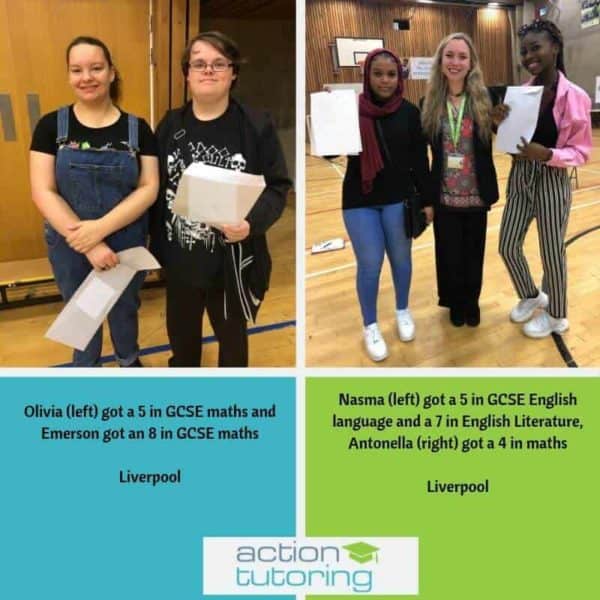
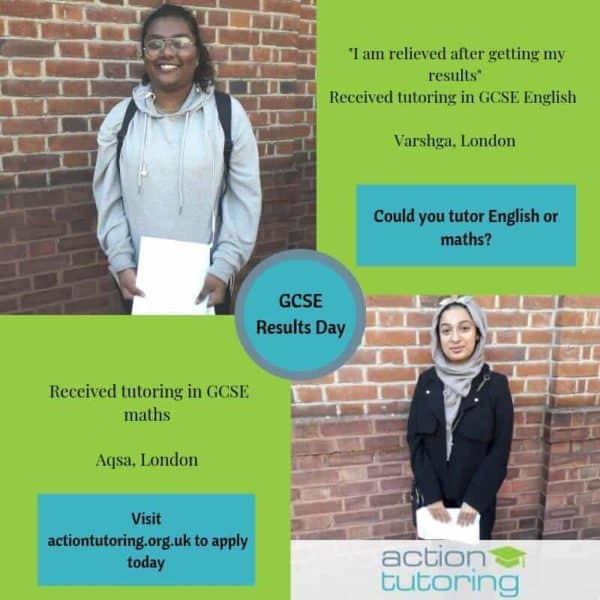
Nilam, a pupil who attended one of our maths programmes in London, got a 5 in maths and said, “Action Tutoring really helped me. Now I can go to sixth form and do the A Levels I want”. Maya, who participated in one of our English programmes got a 6 and commented, “Thank you for teaching us everything and helping us to get our results. I would definitely recommend you to the girls in Year 10”.
We shared numerous posts on our social media throughout the day of the happy faces of our pupils after receiving their results. Our Programme Coordinator for Liverpool, Hannah, got some lovely photos of pupils in Liverpool who were incredibly happy with their grades.

We received some really positive feedback on how our fantastic volunteer tutors have supported them: “Both my tutors helped me a lot. In September I’m going to college to do Health and Social Care and I want to be a midwife.” Another pupil said, “I would like to thank you so much for helping me in maths. I’ve never felt more understood and listened to. Your methods really helped.”
We are thrilled with our pupils’ results this year and would like to thank all of our volunteer tutors for all their hard work in supporting our charity. The autumn term is fast approaching and we are looking forward to working with more pupils and volunteers in the coming months. We still have lots of spaces left to help out, so do get in touch if you’re interested. We are also very excited to be launching in Nottingham this term and expanding our reach further.
If you would like to get involved, simply complete our short online application form to become a volunteer tutor with us today. Help young people achieve and reach their potential in English and maths.
Ensuring GCSE Results Day is a celebration for all
23 August 2019
GCSE Results Day marks the culmination of a year’s worth of hard work and effort by both pupils and teachers. In recent times, schools have faced the added struggle keeping on top of curriculum changes and improving pupil grades against a tough funding climate, something we’ve heard about repeatedly from our partner schools across the country. Yet, this is a time when we really should not be compromising our support for these young people, particularly those who are facing socio-economic disadvantage.
The recent Education Policy Institute (EPI) Education in England report showed that at secondary level, disadvantaged pupils are 18.1 months behind their peers by the time they finish in formal education. In fact, the EPI report suggests if this pace continues, it will take 560 years before disadvantaged pupils and their peers are reaching similar outcomes – a staggering and deeply troubling figure.
Sadly, today’s national GCSE results will no doubt be an illustration of what these statistics look like in reality, demonstrating the impact socio-economic disadvantage is having on the lives of thousands of young people across the country. By missing out on the grade 4s, 5s and above, their futures will be a much tougher climb than their peers to access further education, employment or training. Yet, the results they receive today are not a reflection on their ability; they instead reflect the challenging circumstances these pupils are living with – without access to the same levels of support and opportunities as their peers.
One example of these opportunities is private tutoring. The Sutton Trust’s annual poll confirmed that 41% of pupils in London have had a tutor, and that nationally the figure remains high at 27%. As a mother myself, I understand why so many parents will pay for tutoring: parents really do want the best for their children. If that means paying for a tutor to support them in their learning, that’s something that they will do if they have the means. But for the majority of disadvantaged young people that is simply not an option their parents can afford.
At Action Tutoring we know how impactful tutoring can be, with strong evidence backing this up. We are working now to provide tutoring support to disadvantaged pupils to ensure they are not being sent down the path that the research so sadly predicts. Our aim is that they can leave school with the qualifications that will enable them to progress to further education, employment or training and avoid the cycle of becoming NEET. The way we deliver our support is, in many ways, quite different to private tutoring: we work in partnership with schools and our tutors are all high quality volunteers – generously giving their time to make a difference to the lives of these young people.
In 2017-18 our impact analysis showed the disadvantaged pupils we supported were able to match the national pass rate, after the equivalent of two terms of weekly tutoring, at GCSE level despite the extra hurdles they faced. This is despite the pass-rate for disadvantaged pupils tending to fall 15-20% behind the overall national figures, in English Language and maths GCSEs respectively. We are eagerly waiting to hear how our pupils from this year have got on – we hope it’s a day of celebration for them all, and that we’ve have helped to place them on a firm footing alongside their peers.
This year we’ve supported over 2,400 pupils through a network of over 1,100 volunteer tutors across seven cities in England, at both primary and secondary level. Our impact and evidence base is ever growing: tutoring works and we’re proving that our model works too.
At our Impact Report event earlier this year Rt Hon Nick Gibb MP, shared his support, “[Action Tutoring’s 2017-18 Impact Report] shows that it is possible to close the attainment gap and Action Tutoring has had huge success raising attainment. The pupils are proof that regardless of your circumstances, it is possible to get crucial English and maths qualifications. Action Tutoring offers a practical, structured solution. Action Tutoring’s vision is one that I fully endorse.”
The attainment gap predictions do not have to be the reality. We are changing the outcomes for these young people today and want to ensure that results day becomes a day of celebration for everyone. If you’re interested in supporting us on our mission, by volunteering with us as a tutor or in other ways do take a look at our website: www.actiontutoring.org.uk.
About the author:
Susannah is the founder and CEO of Action Tutoring. Susannah was inspired to start the organisation following experiences working in the charity sector and as a private tutor, recognising the potential to make the benefits of tutoring available to those that might not otherwise afford it.
Susannah has worked in the charity sector since 2007 in roles including research and project management. She has a particular interest in using the potential of volunteers for social change.
Susannah graduated from the University of Cambridge, where she studied Theology at St John’s College. She holds a Masters from King’s College London in Politics, Theology and NGOs, where she wrote her dissertation on the interplay between state and third sector welfare provision.
For more information about Action Tutoring or enquiries about further interviews please contact:
Fleur Nicholson
Marketing and Communications Manager
E: fleur@actiontutoring.org.uk
T: 0203 872 5894
Notes to editors
Since 2012, the charity has continued to grow and now operates in eight cities and areas across England: Birmingham, Bristol, Liverpool, London, Newcastle, Nottingham, Sheffield and Sussex.
In 2017-18 nearly 2,500 pupils were supported by over 1,100 volunteer tutors in 80 schools across the country. These pupils were able to match the national pass rate, after the equivalent of two terms of weekly tutoring, at GCSE level despite the extra hurdles they faced. Nationally only 44% of disadvantaged pupils are able to meet this benchmark.
In the same year 72% of primary pupils supported by Action Tutoring achieved national standards in their SATs.
Research carried out by the Education Endowment Foundation showed that pupils make up to five months additional progress, during an intensive tutoring programme.
The average cost of a private tutor in the UK is £30 per hour. Action Tutoring is able to deliver this to a disadvantaged pupil completely free of charge through the use of volunteer tutors. Donations, grants and school partnership contributions fund the cost of delivery and the Action Tutoring staff team.
There are almost 800,000 young people leaving school each year without the qualifications to go on to education, employment or training. Individuals not in education, employment or training cost an average £56,000 to the UK economy each year.
You can read Action Tutoring’s latest Impact Report here: https://actiontutoring.org.uk/wp-content/uploads/2019/03/Action-Tutoring-Impact-Report-2017-18.pdf and further information is available at: www.actiontutoring.org.uk/our-impact/