Experiences
The value of open-ended questions
13 September 2019
September has rolled around again and it’s the start of another academic year. If you’re completely new to volunteering with Action Tutoring, you’ve probably started wondering how you’ll connect with your pupils during sessions.
Some questions you may have as a tutor:
- How will I help my pupils reflect on their learning?
- How will I extend their thinking?
- How will I encourage them to share their thoughts?
- How will I support my pupils to draw connections?
I know that I spent a great deal of time turning over questions such as these while I was completing my teacher training course. The answer? Open-ended questioning.
Why are open-ended questions important?
Effective questioning can challenge pupils and provide the adult with an insight into how they think and process information. An open-ended question offers a range of responses, rather than having a prescriptive set of answers.
An example of an open-ended question versus a closed question:
- What did this character say?
- Why do you think this character said that?
At first, asking open-ended questions might seem a little contrived and awkward. For many of us, our default is to ask closed questions, which seem to occur to us more naturally. Closed questions also seem to provide an easy shortcut to assessing pupil learning. The pupil’s answer is either right or wrong, which can indicate whether the pupil has understood the content.
However, this is not the whole story. Closed questions do not require the same level of cognitive challenge as open-ended questions, which provide scope for personal interpretation and shades of opinion. Open-ended questions also provide an opportunity for pupils to engage in higher order-thinking, by giving them the chance to reason, reflect and analyse.
What are some ideas for some effective open-ended question sentence starters?
- What do you think…?
- How might you decide…?
- Why do you think…?
- How do you feel about…?
- Why might someone disagree…?
- How did you come to this conclusion…?
With a bit of practice, you’ll quickly learn how to master open-ended questioning.
How does that prospect make you feel?
If you would like to gain tutoring experience, enhance your skills and help disadvantaged pupils receive the academic support they need, get involved with Action Tutoring.
GCSE Results Day – celebrating our pupils’ successes
30 August 2019
It has been a week since GCSE Results Day and we would like to reflect on the successes of our brilliant pupils and volunteers.
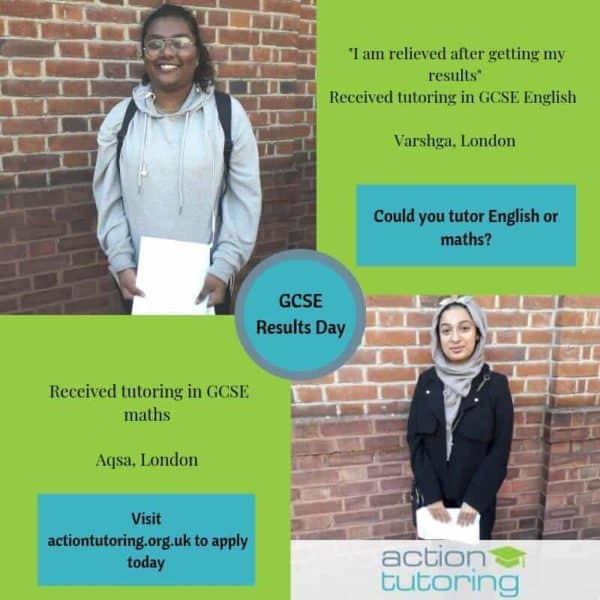
GCSE Results Day is an incredibly important date in Action Tutoring’s calendar and we were out and about in our partner schools to celebrate in the successes of our 2019 Year 11 pupils.
There were some really fantastic achievements we heard about on the day and wanted to share them here. As a charity we focus on supporting pupils who, at the start of the year, are at risk of not achieving a grade 4 in these crucial exams…
Nilam, a pupil who attended one of our maths programmes in London, got a 5 in maths and said, “Action Tutoring really helped me. Now I can go to sixth form and do the A Levels I want”. Maya, who participated in one of our English programmes got a 6 and commented, “Thank you for teaching us everything and helping us to get our results. I would definitely recommend you to the girls in Year 10”.
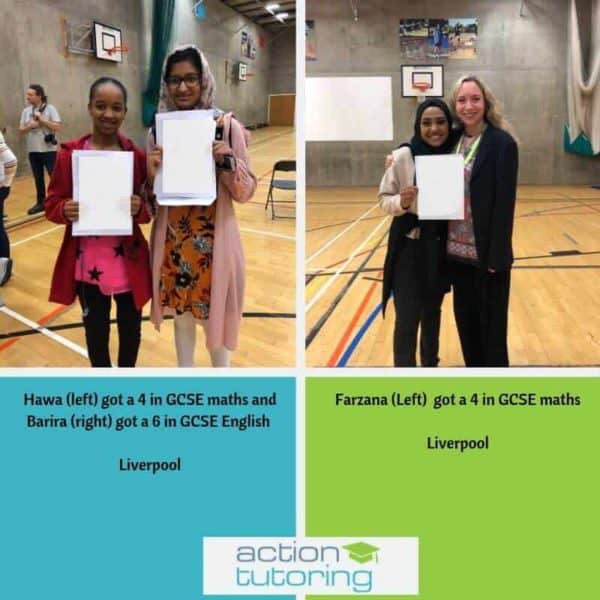
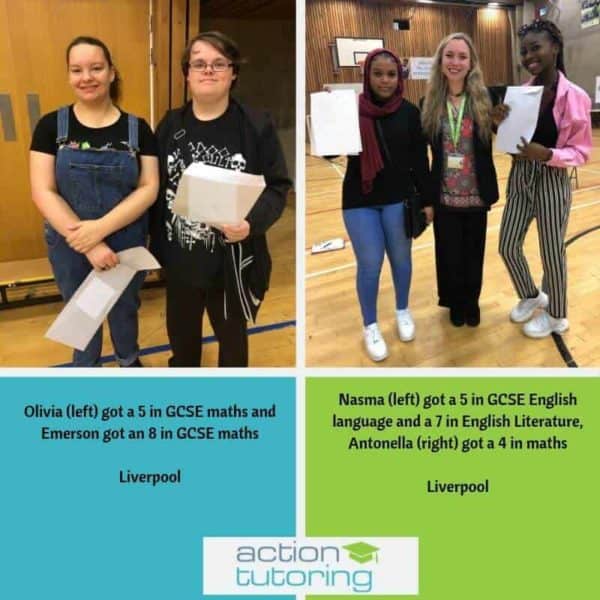
We shared numerous posts on our social media throughout the day of the happy faces of our pupils after receiving their results. Our Programme Coordinator for Liverpool, Hannah, got some lovely photos of pupils in Liverpool who were incredibly happy with their grades.
We received some really positive feedback on how our fantastic volunteer tutors have supported them: “Both my tutors helped me a lot. In September I’m going to college to do Health and Social Care and I want to be a midwife.” Another pupil said, “I would like to thank you so much for helping me in maths. I’ve never felt more understood and listened to. Your methods really helped.”
We are thrilled with our pupils’ results this year and would like to thank all of our volunteer tutors for all their hard work in supporting our charity. The autumn term is fast approaching and we are looking forward to working with more pupils and volunteers in the coming months. We still have lots of spaces left to help out, so do get in touch if you’re interested. We are also very excited to be launching in Nottingham this term and expanding our reach further.
If you would like to get involved, simply complete our short online application form to become a volunteer tutor with us today. Help young people achieve and reach their potential in English and maths.
Zayn’s thoughts on starting secondary school
16 August 2019
This September, thousands of 11-year-olds across the UK will be making the exciting and nerve-racking jump to secondary school. In the coming weeks, they will flood into town with their families to pick out their new uniforms and update their pencil cases in preparation for the next milestone in their lives.
However, the transition to secondary school can be overwhelming. In fact, disadvantaged pupils are at risk of falling behind their more affluent peers by two months per year over the course of secondary school (Education Policy Institute, 2017).
Although the Year 6 pupils we have worked with at Action Tutoring have performed brilliantly in their SATs exams, I cannot help but wonder how they will settle into their new schools.
To gain more of an insight into how they might be feeling, I sat down with my nephew, Zayn (age 11), to ask him a few questions:
How do you feel about starting secondary school?
I’m feeling nervous but excited. When I started primary school I was the youngest but moved on to Year 6 and became the oldest. When I go to Year 7 I will be the youngest again… But I am kind of happy to get a sense of independence.
What do you feel nervous about?
The school is so big and it will be hard to find the different classes.
What has helped you to feel prepared for secondary school?
1) Tutoring – my mum has signed me up for physics tutoring and I really enjoy it.
2) My school had an assembly where secondary school teachers came in and told us about what it will be like and how to stay calm.
3) I spent a day at my new school and that helped me.

Zayn says goodbye to his friends after 7 years at Primary School
If you had three wishes for secondary school, what would they be?
1) Stick with my friends who are coming to the same school as me.
2) Try more subjects like history and get better at them.
3) To play for the school football team so that I can play against different teams
… Oh and I don’t want to get detention because it is going to be long!

Zayn (centre) and family enjoying the summer holidays
Through our volunteer tutoring we have an amazing opportunity to help pupils feel heard and supported by being mindful of what it feels like to be in their shoes. We can share our own experiences, build their confidence and encourage them to try their best to develop!
In praise of podcasts: five things I learnt about education from podcasts
9 August 2019
Rewind to the late 2000s. I’d received a really cool mp3 player for Christmas, shaped like a jelly bean but made out of glimmering pearl-like plastic. It provided perfect entertainment for commuting. Until one day it squirmed its way out of my hand, executing a perfect somersault, and plummeted directly through the gap between the train and the platform edge. Panicked, I listened to it clunk against the rails, followed swiftly by warning tones that the doors were about to close and so jumped off the train impulsively, a little lost without the entertainment I’d been relying upon!
Thankfully I’ve not repeated this escapade with my current entertainment device – old habits die hard though, and I’ve still picked a similar glimmering white colour scheme from the many options available. Anyway, what was the reason for me sharing this whistle-stop tour of recent audio technology? For many of us, all sorts of tasks (commuting included), are now accompanied by our own choice of entertainment, plugged straight into our ears. Instead of noughties pop my companion is often a podcast and there are plenty on education that are both interesting and informative. Here are five things I learnt about education from podcasts:
- Homework and class sizes appear to influence pupils’ outcomes less than we think.
from BBC The Educators – John Hattie
This podcast interviews a number of big thinkers in education, and is well worth a listen. This particular episode with John Hattie includes some information about his meta-analysis of education research and how it can help us understand what might, and might not, make a difference to pupil outcomes. As I learnt at a recent event, there is a tension in meta-analytical work between the quantity and quality of studies to include – although more studies might initially seem better, this isn’t necessarily the case if they are not equally high-quality and ‘translatable’ to new and differing contexts. All the same, the work of the Education Endowment Foundation also shows that homework and class sizes might not be as significant as we might think.
- It usually takes examiners 18 months to craft an exam paper!
From Inside exams – 1. Talking my language
It would be easy to ignore what routes test papers go through before they arrive on exam desks in the summer term. This podcast walks us through some of the processes involved in creating, reviewing and checking exam papers. A great way to learn more about exams, direct from the examinations boards themselves.
- How wide the gap is between pupils’ everyday talk and the academic vocabulary they need to succeed in school, as well as how to bridge this gap. From Mr Barton podcast – Alex Quigley: Closing the vocabulary gap
Everyone is a teacher of language and this is a really interesting topic for both maths and English tutors – as well as any prospective teachers of other subjects. Alex Quigley is a former English teacher and now works at the Education Endowment Foundation.
- Why number lines make more sense vertically than horizontally, and how the language of ‘opposites’ can be useful in teaching negative numbers
From Mr Barton podcast – Bernie Westacott
Mr Barton is basically education podcast royalty. He’s interviewed many influential figures for the podcast, which is regularly listened to and discussed by the most maths-phobic teachers. You know when Mr Barton likes something because he says, “that’s flippin’ brilliant” and he says that a lot in this podcast, which is available to listen to as well as to watch. It gives some great context to what pupils will have experienced early on in primary school as well as great tips for teaching negative numbers. I’m a big fan of vertical number lines since watching this. Why? They link to real-life examples (think thermometers and lifts) and the higher up a number is, the bigger it is. With a horizontal line, you lose these clear links and in their place it all becomes more ambiguous for pupils.
- Why it’s desirable that pupils find things difficult, and the importance of ‘wait time’ after we ask questions.
From Evidence based education – Robert & Elizabeth Bjork
The Bjorks are incredibly knowledgeable and influential researchers on learning and memory. This is the sort of podcast that really makes you think about how complex learning is, and helps question the assumptions we’ve picked up along the way. It’s worth a listen to understand that when pupils find tasks hard, it might not actually be having a negative impact on their learning. For a quick written summary, I’d recommend this article. ‘Wait time’ is all about how much silence we leave, after asking a pupil a question. Often, it’s tempting to break the silence and either answer the question ourselves or rephrase it. Both approaches might result in pupils not having the time they need to think deeply about the question and formulate a response. Plus, we are tacitly telling them they don’t always need to think about the questions we pose – as we might answer them ourselves! If you want to know more about their research you can also listen to their interview on Mr Barton’s podcast and their YouTube channel.
More education podcasts I’ve enjoyed:
BBC more or less – delves deep into statistics (often sent in by the audience) and provides great examples of mathematical ‘answers’ that aren’t always simple and can be controversial or used as a starting point for debate.
TES – the education podcast – TES news is great for what’s going on in schools, and TES ‘pod-agogy’ (yes, I love that pun!) for teaching tips.
The Dysadvantage podcast – experiences of people with dyslexia: exploring how they cope with the challenges it poses and the advantages they feel it brings.
TED Talks education – more global and wide-ranging in topics, great if you want a broader view of education beyond tutoring and the UK system.
The NCETM Maths podcast – aimed at maths teachers, but there are some great episodes on the maths mastery approach and interviews with maths teachers.
Trialled and tested – a collaboration between the Education Endowment Foundation and Evidence Based Education, discussing key pieces of education research.
What I’m listening to next: Researcher Daniel Willingham’s keynote at a recent ResearchED. Willingham’s book ‘Why don’t students like school’ has been a big influence on me. The quote ‘memory is the residue of thought’ is a really pertinent one for anyone in education, so I’m looking forward to hearing what Willingham has to say.
The Power of Yet: How discovering Growth Mindset had an impact not only on my teaching but on my path to self-care
2 August 2019
When I first started teacher training, Carol Dweck’s research on Growth Mindset formed a central part of the training I received. I was so inspired by everything she said, especially by this quote:
“Instead of luxuriating in the power of yet, they were gripped in the tyranny of now.” (Carol Dweck, 2014)
I realised I definitely had a growth mindset professionally. I knew I was on a learning curve to becoming a teacher and I wanted to embed Growth Mindset strategies into my teaching practice. I can confidently say that I was able to do that. There was nothing more rewarding than, after a few months, hearing my pupils use these phrases with each other:
“I’ve tried really hard today.”
“I can see you’ve put in a lot of effort.”
“Wow, you didn’t give up with this tricky sound, well done!”
In my classroom and in my teaching practice, I had embedded a culture of continuous learning, growth and positivity, and I could see this in the way my pupils were starting to use my growth mindset language in their everyday life. However, in my personal life, everything was spiralling out of control.
Whilst struggling with missing my family, having no work-life balance and challenges with my mental health, I realised I was gripped in the tyranny of now, barely coping with the anxiety that was swallowing me up. I could see no way out. It was around that time that I started watching the Netflix series, Queer Eye, and was really struck by what one of the main stars of the show, Jonathan Van Ness, said:
“To me, self-care isn’t really shallow. Showing up for yourself, putting on a little moisturizer, can inspire so many different parts of your life.” (Jonathan Van Ness)
I realised I was not showing up for myself. I was not eating well, not exercising, not sleeping well, not taking time to myself, not taking care of my skin…So, after watching the episode, I bought myself a face moisturiser and a face wash. I knew that my wellbeing was not going to improve magically, and I needed to put in the effort and I could take self-care one step at a time. It might seem silly to some that a little bit of moisturiser would have such an impact on my wellbeing, but it wasn’t the moisturiser itself, it was what it represented: my first step in buying something to take care of myself. As people say, the journey of a thousand miles starts with one step.
One year on, recent steps I’ve taken to improve my wellbeing are: I joined an exercise class, I included more vegetables in my diet, I socialised more with friends…
The road to loving and taking care of yourself is long and I am not there yet, but I am luxuriating in this ‘power of yet’ and am miles further than I was this time last year, and I feel great.
Now, as Programme Coordinator at Action Tutoring, I aim to always include Growth Mindset training within the first few weeks of my programmes, hopefully inspiring tutors to use Growth Mindset techniques in their tutoring, just as Carol Dweck inspired me. This will not only have a profound impact on the pupils, but perhaps on the tutors as well.

Volunteering Experiences – Primary school
3 July 2019
Stefanie Bongert is a Systems Consult at SustainIt and has tutored maths to primary school pupils with Action Tutoring. Stefanie has attended fifteen sessions and shares her volunteering experience below.
SustainIt offers each employee the chance to volunteer for a charity of their choosing for two days, every year. I decided to volunteer with Action Tutoring in Bristol, who support disadvantaged pupils in local primary and secondary schools, by offering tutoring sessions for maths and English.
Every tutor works with the same group of two or three pupils, for one hour a week over the period of one term (8-10 weeks), with the option of continuing the following term.
Why did I volunteer as a tutor in a primary school?
Having previously studied English and Maths to become a teacher, this volunteering opportunity seemed like a perfect fit. The main reason behind my interest in volunteering with Action Tutoring was that I wanted to commit to an entire term as I really think that it is important to only start something that you can dedicate enough time to.
I also particularly like the fact that you work in a room full of other volunteers, working with pupils of the same age group. We get the chance to help each other and share ideas during the sessions, or in our 10-minute catch-up after each volunteering session.
During each session, we try to concentrate on a specific topic, including time for both group and individual work. During the small breaks between longer tasks, we play mathematical games or try the brain teasers in the workbook. Figure 1 shows an example of some of the activities we ask the children to complete. Can you solve the triangle mess and count the triangles?

It is great to see the students enjoying the sessions when we get to a topic they find engaging. Sometimes, they almost forget that they are doing maths.
It has been important to get to know my pupils a little bit during the first session and observe what they enjoy in the following session. It is a great chance to plan the lessons with a mix of tasks they need more practice on, as well as those they enjoy and leave them with a sense of achievement.
Written by: Stefanie Bongert, Systems Consultant
Originally published https://sustainitsolutions.com/blog/volunteering-at-a-local-primary-school/
If you want to give back to your community and also volunteer like Stefanie in your area or online, get involved today and support disadvantaged pupils by providing them the academic assistance they need.
Olivia’s top tutoring tips to make lessons more engaging
21 June 2019
Lesson Ideas For Primary English Tutors
Based on my experience of volunteering with Action Tutoring in two Bristol-based primary schools, here are my top tips for making sessions as useful for the pupils as possible.

Rules
Each week we establish a list of three rules for the pupils to stick by during the session. This acts as a great incentive to keep them focused and working hard. If a rule is broken, the pupil receives a strike next to the rule.
If the pupils succeeded in not getting more than three strikes next to each rule, then they would be rewarded with a sticker at the end of the session. From my experience, incentives such as stickers worked extremely well for keeping the pupils on track and motivated, as they really enjoyed having a realistic and tangible goal to work towards.
The Lesson Plan
While it is widely recognised that the importance of planning ahead is paramount to the success of tutoring sessions, I find that openly discussing this plan with my pupils before beginning the session is just as important. So, although I was always sure to plan ahead, my pupils and I would always make a rough plan of the session all together at the start of the session, which would often just consist of four or five bullet points with a tick box next to each activity.
Having the plan written down was key as it would allow pupils to stay on track, but more importantly, it allowed them to take turns ticking things off the list when an activity was completed, which motivated them to keep pushing on and achieve lots with each session.
For example:
- Play a warm-up game
- Read two paragraphs from the text
- Highlight words we don’t understanding as we go along
- Add 3 new words and synonyms/antonyms to our word journals
- Attempt five questions from the workbook
Games
One of the most engaging tutoring tips for pupils is definitely word games. Starting each session with a game meant that the pupils looked forward to the sessions and, therefore, put them in a positive and eager mindset to learn.
One that always went down well in my sessions the pupils liked to call “the category game”. This involves the tutor choosing one letter in the alphabet, writing a list of 10 different categories (e.g. four letter words, modes of transport, verbs), and setting a timer of three minutes in which the pupils try and come up with an answer for each category. For example, if the letter were ‘B’ and we used the former examples as the first four categories on the list, the first four answers could be: busy (four letter words), bus (modes of transport), and borrow (verbs).
Content
As the pupils would often get bored or easily distracted, I found the sessions to be most effective when we would stick to one section of the text rather than attempting to tackle the whole thing. This would often overwhelm pupils, further knocking their confidence and consequently their productivity.
Sticking to smaller sections would help to keep the tasks manageable, increasing the chance that the pupils would remain engaged.
Do you want to build your tutoring experience? Join our community!
Written by: Olivia Poust
Reflections from a tutor: The Action Tutoring experience
17 May 2019
Written by Elaine Garrod
Elaine is a graphic designer working for KPMG and tutors English with Action Tutoring at Chelsea Academy.
It is generally said that moving house is one of the most stressful life events one can have. I dare say general advice would be not to take on other new ventures at the same time, if it can be avoided.
However, one afternoon last spring as I was heading to my work’s restaurant for lunch in a state of angst over my impending house move, I was approached by a man who was trying to recruit KPMG staff members to volunteer for a charity called Action Tutoring. I work for KPMG as a graphic designer and the company allows its staff time during working hours to volunteer with all sorts of charities and activities as part of its ‘Corporate Social Responsibility’.
The man from Action Tutoring explained to me that the charity supports pupils from disadvantaged backgrounds to achieve a meaningful level of academic attainment, with a view to helping them progress to further education, employment or training. It does this by getting volunteer tutors to help pupils with maths and English. Despite the pressure I was under at the time, I agreed to become a volunteer tutor. Why, you ask?
I try to live Green Party values, be a useful member of society and do good in the community. In the Green Party, we promote equal opportunities and believe that every child has the right to a good education and the right to have the opportunity to reach their full potential, whatever their circumstances. Children from poorer backgrounds can face challenges such as having to care for younger siblings or sick/disabled parents. They might live in a crowded home and not have anywhere quiet and private to do their homework. They might not get enough to eat. Issues like these can seriously affect the time they have for studying and their ability to focus on their studies, not to mention their confidence and aspirations. I wanted to do something to help them.
To become a tutor you need to have at least ‘A’ Level in the subject you’re going to teach. I can therefore only teach English: as I tell my pupils, if we were in the maths classroom they would be teaching me!
The first steps were to apply for DBS clearance and attend an induction course with other new tutors where I learned some shocking statistics about how poorly pupils from less privileged backgrounds do in their exams compared to their more privileged peers. We were shown the workbooks we would use, although we were told we could use our own material and teaching aids too, so long as we ran them past the coordinator first. We were given a few rules regarding safety for ourselves and the pupils.
Soon after that, I was invited to look through the list of schools where tutors were required and apply for a position. I chose to apply to teach GSCE English to Year 10 and 11 pupils for an hour a week during term time at Chelsea Academy. There are primary school roles available too but they are at 09:00 and I’m not a morning person! The secondary school sessions are in the afternoon.
The benefits to the pupils are fairly obvious: the tutoring, which is one-to-one or in small groups can help them get better grades in their exams which will boost their chances of getting into higher education and a good job. However, there are also benefits for me.
Teaching English writing and reading comprehension makes a change from work for me and inspires me to think more creatively which is useful for my job, as is gaining skills and confidence in teaching as my job sometimes involves buddying apprentices. I find that helping the pupils to understand and analyse different types of text sharpens my own analytical skills and enhances my appreciation of what I read, be it a novel or a newspaper article. I’m always on the lookout for text that I could use for a good comprehension lesson so I read all the more attentively, looking out for interesting structures, forms, and language techniques. I find myself thinking back to books I’ve previously read and revisiting them to mine them for texts to use for a lesson. I’m re-learning a lot as I go along, and reading the different texts with the pupils is broadening the range of things that I read too. Another way in which it is good for me is that while I’m teaching I’m completely absorbed in it and focused on my pupils and their progress: I’m not thinking and worrying about other things (which I’m given to doing).
I was a little nervous before my first lesson as I wasn’t sure exactly what to expect from the venue and the pupils. When I arrived at the school I joined the coordinator and other tutors, who are quite a diverse bunch, in the foyer. Most of us were there early so we had time to chat amongst ourselves before being led up to the classrooms (one for English and one for maths) to meet our pupils. I was supposed to have two pupils but only one of them, a Year 11 girl, ever turned up. This was in May, so I only had her for about three sessions before she started her final exams; then we were introduced to our Year 10 pupils. It can be a little awkward at first until we get to know each other. I start off by asking them questions about what subjects they enjoy in school and what they want to do when they leave school, and I tell them a bit about myself, or get them to play a guessing game as to what I do for a living and so forth. Sometimes we then play a game like ‘Taboo cards’ as a warm-up before the lesson proper.
Although we are provided with workbooks, it’s advisable always to have a ‘back-up’ lesson as sometimes we are given different pupils due to absences. Rather than disrupt what I’m doing with my usual pupil, or what my temporary pupil is doing with their tutor in the workbook I find it’s better to do a ‘stand-alone’ lesson in these cases. I’ve found all my pupils to be polite, respectful and hard-working and I hope to continue tutoring for the foreseeable future.
If you’re interested in giving up some of your time to help disadvantaged pupils visit the Action Tutoring website:
https://actiontutoring.org.uk/