
Connecting pupil wellbeing and attainment
As we mark Mental Health Awareness Week, it is an ideal time to reflect on the intrinsic link between a pupil’s emotional resilience and their academic outcomes. We know that for school leaders, the pressure to meet progress measures and close the attainment gap is constant. Yet, as every practitioner sees daily, a pupil’s ability to engage with the curriculum is inseparable from their mental and physical wellbeing.
At Action Tutoring, we view pupil wellbeing and attainment as two sides of the same coin. By providing consistent, supportive interventions, we aim to help schools remove the barriers that prevent young people from focusing on their learning. This week, we are highlighting how a holistic approach – one that prioritises a child’s sense of security and confidence – is often the most effective way to unlock their true academic potential.
The evidence: What the data tells us
The link between a pupil’s mental health and their ability to learn is backed by significant research. According to UK government guidance, pupils with better health and wellbeing generally achieve better academically.
Specifically, the Department for Education (DfE) highlights that:
- Pupils with no emotional or behavioural problems at age 11 achieve, on average, the equivalent of one grade higher at GCSE than those with even mild problems.
- Schools that implement an “integrated” approach to wellbeing – where mental health support is woven into the school culture – see a marked improvement in attendance and engagement.
The Children’s Society also notes that “subjective wellbeing” (how a child feels about their own life) is a significant predictor of their future educational trajectory. If a child feels safe, supported, and heard, their “working memory” is freed up to focus on algebra or creative writing, rather than navigating emotional distress.
The attainment gap: A health and wealth divide
While wellbeing matters for every child, the stakes are highest for those facing socio-economic disadvantage. Pupils eligible for Free School Meals (FSM) are statistically more likely to face “adverse childhood experiences” (ACEs) or persistent “toxic stress” related to financial insecurity.
Pupils from low-income households are more likely to experience mental health challenges but are often less likely to have access to private support or extracurricular outlets that build resilience. For these pupils, the classroom can either be a place of further stress or a vital sanctuary. This is where targeted intervention, such as small-group tutoring, plays a dual role.
How tutoring bridges the gap
Tutoring is traditionally seen as an academic intervention, but at Action Tutoring, we see the profound impact it has on pupil wellbeing and attainment simultaneously.
For a pupil eligible for Free School Meals (FSM) who may be struggling with confidence, the presence of a consistent, encouraging volunteer tutor can be transformative.
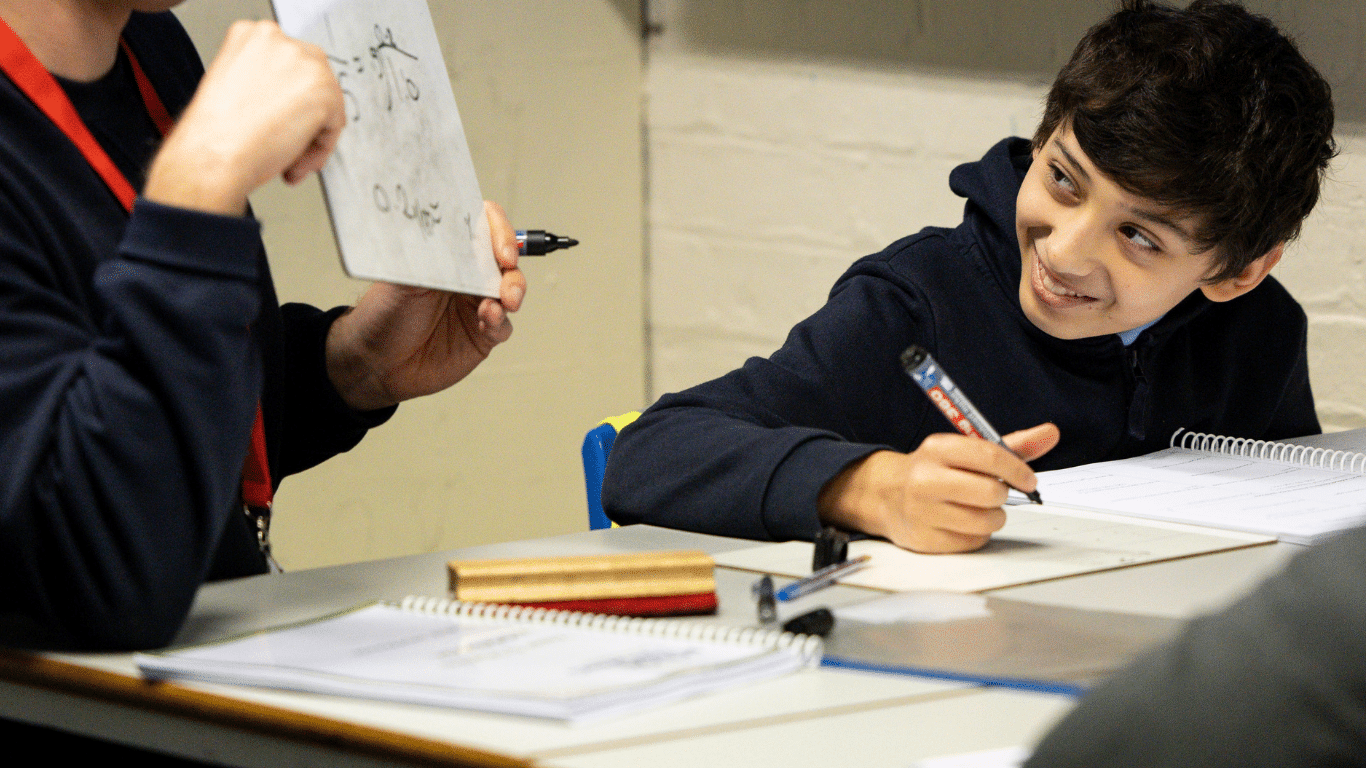
Our tutors provide:
- A safe space to fail: In a class of 30, a pupil may be too anxious to raise their hand. In a 1:3 tutoring session, they can make mistakes and ask “silly” questions without fear of judgment.
- Emotional regulation: Mastering a difficult maths problem doesn’t just improve a grade; it provides a “win” that boosts self-efficacy and reduces school-based anxiety.
- Positive role modelling: For volunteers, their impact goes beyond the curriculum. They are stable, supportive adults who show pupils that their education – and their future – is worth investing in.
“I quite look forward to having a little chat, because sometimes it’s not always about the work.”
Kobie, Year 6 pupil at Holy Trinity Primary School in Dorset
A note to our volunteers
If you are reading this and considering how you can help, remember that your time does more than just move a pupil from a Grade 3 to a Grade 4. You are contributing to the holistic health of a young person.
By showing up for one hour a week, you are telling a disadvantaged pupil: “You matter, I am listening, and I believe you can do this.” That boost in confidence is often the exact spark needed to ignite academic progress.
“Tutoring has been really helpful. I’ve definitely noticed the difference since my last mock and I feel more confident already!”
Year 11 pupil, Newfield Secondary School in Sheffield
Help us support the whole child
As we look toward the next academic year, our mission remains clear: ensuring that no child’s background limits their potential.
Schools: We are here to partner with you to provide the evidence-based support your FSM pupils need to flourish. Get in touch here.
Volunteers: We need your passion and your empathy to help us reach more young people than ever before. Express your interest in volunteering next academic year here.