
Power hour, powerful impact: Why volunteering as a tutor is the ultimate “win-win”
27 February 2026
Most professionals spend at least an hour a week in meetings that could have been an email. But what if that same hour could change a child’s life?
The attainment gap between disadvantaged pupils and their peers is at the widest it’s been in over 10 years. While many of us have enjoyed successful careers built on the foundation of our own schooling, thousands of young people are currently struggling to reach their potential.
With 14 years’ experience working with wonderful volunteers, we know that the talent needed to close this gap already exists (see our latest impact data). And it could be sitting right there in your office!
Whether you are an individual looking to give back or a Social Value Lead searching for a simple intervention with high-impact to support your social-value goals, here is why volunteering as a tutor is the ultimate professional “win-win.”
1. It fits your calendar
The biggest barrier to volunteering is often time. However, our one-hour-a-week programmes fit seamlessly into the lives of working professionals.
“Flexibility is very important for my day-to-day commitments at work. I am desk based and mainly working from the office, so tutoring sessions are well adapted to people working at offices.”
Javier, volunteer tutor
Whether you are working from the office or home, our online tutoring option means you can make a difference without even leaving your desk. Many of our tutors find that a morning session acts as an antidote to burnout, leaving them feeling energised for the rest of the work day.

2. No teaching degree? No problem.
You don’t need to be a formal educator to be a tutor. We provide the tools, the workbooks, and the training; you provide the encouragement and perspective.
“The workbooks and training are very clear and well laid out. If you come with an open mind and listen to the needs of the young people, you will be able to help them, even if you do not have prior teaching experience.”
Ian, volunteer tutor
3. Tutoring is professional development
Volunteering is of course about giving back, but it’s about sharpening your own edge. Tutoring builds essential transferable skills:
- Communication: Explaining complex ideas simply.
- Leadership: Mentoring a young person through challenges.
- Confidence: Stepping outside your usual working bubble.
“The main benefit for me has been with the increased confidence working with students. I’m hoping to build on that in the future when representing my profession and industry.”
Dave, volunteer tutor

How your company can get involved
Corporate partnerships are instrumental in driving our mission forward. For CSR/Social Value leads, we offer a low-friction, high-impact partnership. We manage the logistics and provide the resources, while your employees provide the impact.
By integrating tutoring into your CSR strategy, you aren’t just meeting social value targets; you are boosting employee retention and wellbeing.
“Action Tutoring has been a strong partner to work with—clear, responsive, and highly organised, with a delivery model that makes it straightforward for our colleagues to get involved and stay engaged.
Luke Richardson, Head of Social Value, Amentum
The quality of their impact data and reporting has been particularly valuable, giving us credible evidence we can take internally to demonstrate the real-world value of our employees’ time.
Just as importantly, the flexibility of the programme—whether tutoring online or in-school, and a manageable weekly commitment—means it fits around the working lives of professional staff.”
Take the next step
Ready to turn your next “spare hour” into a milestone for a pupil facing disadvantage?
- Individuals: Sign up to tutor today
- CSR Leads: Fill out our expression of interest form to book a chat with our Corporate Partnerships Manager.
What we have achieved: Our 2024-25 impact report
26 February 2026
We are delighted to share the benefits our pupils and schools have received from tutoring over the 2024-25 academic year, as highlighted in our latest impact report.
Read on to understand how tutoring continues to benefit those we support.
Solid foundations
Committed to narrowing the attainment gap in English and maths with tutoring as a proven solution, we have built up a robust evidence base, over our 14 years in operation.
Our latest impact report shows we have a foundation of evidence and a proven solution – tutoring with volunteers works.
Read our 2024-25 impact report

The results
In 2025, our Year 6 pupils closed the attainment gap in Reading, while our Year 11 pupils defied the odds at GCSE; with both groups outperforming disadvantaged peers nationally.
Primary schools: Our Year 6 impact
After attending 10 or more sessions with Action Tutoring, 73% of pupils achieved the expected standard in their maths and 81% achieved the expected standard in their Reading SATs. In fact, for the first time this year, we didn’t just narrow the attainment gap with this year group, we closed the attainment gap completely in Reading. Our Year 6 pupils met the national reading standard at the same rate as their non-disadvantaged peers.
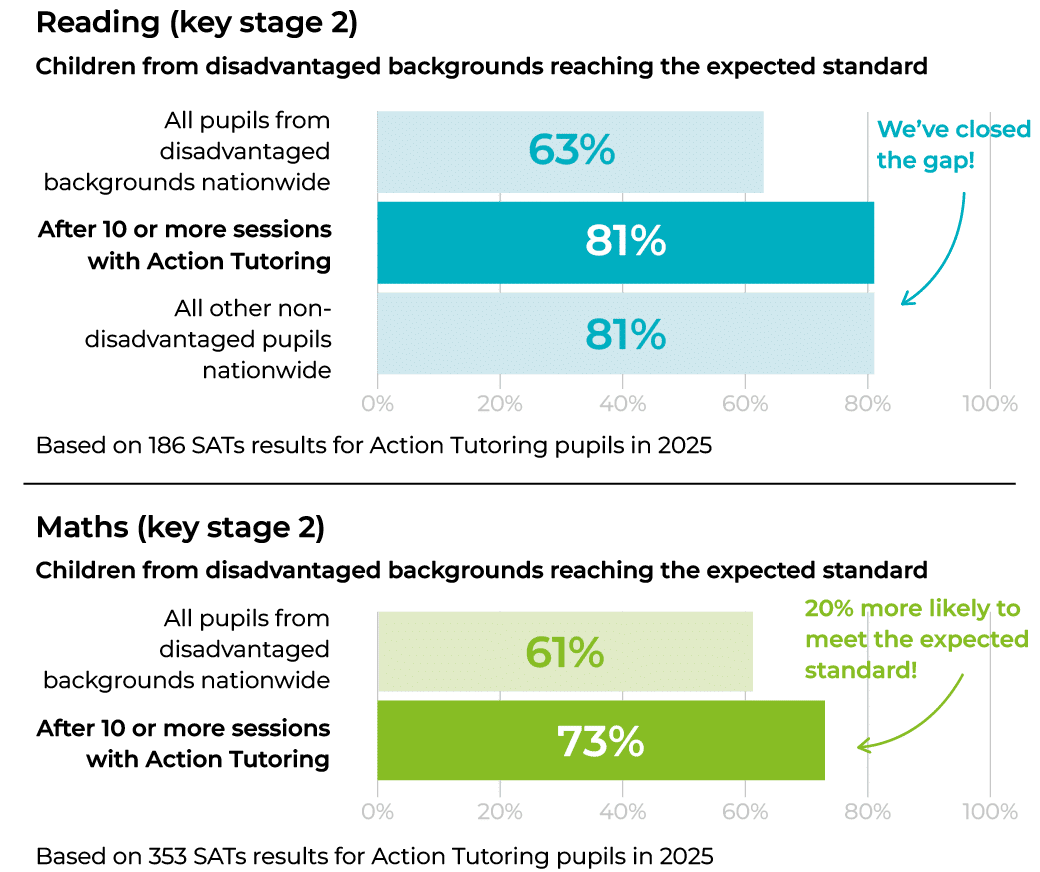
Action Tutoring pupils were 20% more likely to meet the expected standard in maths and 29% more likely to meet the expected standard in Reading than other disadvantaged pupils nationwide in their SATs.
Teachers select pupils to take part in Action Tutoring programmes that are at particular risk of not meeting this benchmark in their key stage 2 SATs. This makes their achievement all the more meaningful.
Secondary schools: Our Year 11 impact
60% of pupils passed their GCSE maths and 57% passed their GCSE English (after attending 10 or more sessions with Action Tutoring), compared to 53% and 52% of disadvantaged pupils nationally.
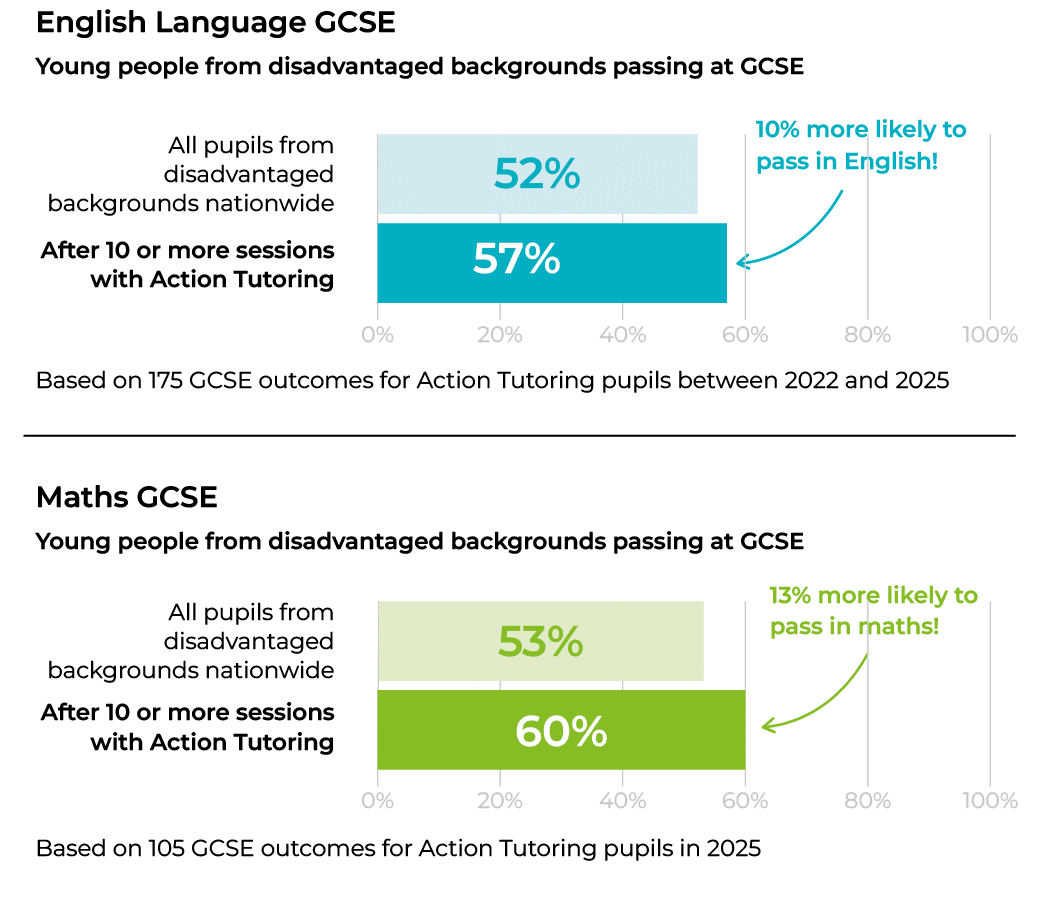
Action Tutoring pupils were 13% more likely to pass GCSE maths and 10% more likely to pass English than disadvantaged peers nationally.
An independently quality-assured study found our pupils achieve similar outcomes whether they are tutored online or face-to-face.
Unrivalled scale of impact
In addition to these impressive achievements by pupils on our programmes:
- We mobilised 1,401 tutors to deliver 42,479 sessions, reaching over 3,700 high-potential pupils, through partnerships with 102 schools.
- We were recognised as the “School Partnership Provider of the Year” at the National Tutoring Awards 2025.
- We expanded our delivery into more high-need, underserved communities including Blackpool, Cumbria, Devon, and Dorset.
Excellent endorsements
We are proud of the strong partnerships we develop with schools across the country. But don’t just take our word for it:


Thank you
We hope you enjoy reading through the publication and reflecting on our work together. We want to thank everyone involved for their contribution to Action Tutoring’s mission across the 2024-25 academic year. Every child has the potential. Your family’s income should not determine your chances of success. Our impact data consolidates our commitment to lead on closing the attainment gap across 2025-2026.
Looking ahead
As part of the 2025-26 academic year, we are looking forward to reflecting on – and sharing the results of – our Education Endowment Foundation evaluation. The evaluation’s randomised controlled trial format is continuing to assess the impact of tutoring for Year 7, 10 and 11 pupils facing disadvantage, including how this improves their attainment and attitudes. We are excited to learn more about the findings from our innovative approach in 2027.
However, there are challenges which still remain.
Schools are grappling with real-terms funding shortfalls due to rising costs. Consequently, school leaders are forced to make impossible choices, including cuts to vital staffing and beneficial programmes. These reductions disproportionately impact disadvantaged pupils, further compounding the attainment gap. While there was welcome news of the two child benefit cap being scrapped in the 2025 Autumn Budget, school revenue funding was not increased.
While this definitely is a positive step, we still need your support. Read on below to find out how you can help.
Get involved: Ways you can join our mission
There are various ways you can help us to build a brighter future through tutoring. Find out below how you can become involved.
Sign up to volunteer
Ready to volunteer on one of our programmes?
By volunteering for just one hour a week, either in school or online, you will:
- Transform the lives of pupils from disadvantaged backgrounds.
- Give pupils hope in their education.
- Share that lightbulb moment, when a pupil exclaims, ‘I get it’.
- Experience the joy of tutoring.
Thank you!
Spread the word
We would love you to spread the word on all that we do with those you know. Whether it’s your friends, family, colleagues, or someone you know who works in education or at a school, it all helps.
Here are some other ways you can support us this year.
Share our blog
One of the best ways to spread the word on what we do, is by reading and sharing our blog posts.
Whether case studies, policy and advocacy, our curriculum, or fundraising, there’s always something worthwhile.
Recommend us to a school
Do you know of a school, or a teacher who could benefit from our work? Why not recommend us to them! They can simply email: schoolenquiries@actiontutoring.org.uk, call 0300 102 0094, or send them the link to the form below.
Follow our socials
Want to get social and keep up to date on all things impact at Action Tutoring? Simply click on the icons below to follow our channels and share our social posts today.
Ensuring every child can leave school and progress in life: Action Tutoring’s response to the Schools White Paper
23 February 2026
We welcome the publication of today’s Schools White Paper, ‘Every Child Achieving and Thriving’. The Government’s commitment to ending the ‘postcode lottery’ for SEND pupils and its radical restructuring of disadvantaged funding represent a significant step toward a more equitable education system. Ensuring every child can leave school and progress in life is exactly what we, at Action Tutoring, strive to achieve.
From our infancy, as a charity, we have committed to supporting geographical areas where the need is greatest. We are proud of the reach our online model has enabled, from Cornwall to Cumbria, and we have seen the difference this investment is making in these communities. Read more about our work to tackle rural educational challenges here and our moves to Rotherham, Hull and Dorset.
We welcome the Government’s commitment to these harder to reach areas through its ‘Mission North East’ and ‘Mission Coastal’ initiatives. We remain dedicated to providing schools with the high-quality, subsidised tutoring capacity required to support these new national targets.
We wholeheartedly support the Government’s ‘generational’ mission to halve the attainment gap by 2030. However, an ambition of this scale cannot be built on top of existing school deficits; for these reforms to take root, the ‘Inclusive Mainstream Fund’ must be treated as a foundation, not a substitute, for a significant uplift in core per-pupil funding
Additionally we urge the Government to ensure that “flexibility” around resource spend does not lead to a dilution of quality, and that it is directed toward evidence-based, high-impact small-group interventions.
We believe that for tutoring to become a permanent engine of social mobility, schools need the long-term financial certainty to plan beyond a single academic year. We call on the Government to ensure that the path to 2030 is paved with sustainable, ring-fenced investment in the children who need it most.
“We have the evidence, the tutors, and the will to close the attainment gap. Now, we need sustained investment to match the Government’s rhetoric.” Jen Fox, CEO, Action Tutoring
From placement to professional – Elsie’s story
13 February 2026
This Student Volunteering Week, we are celebrating the incredible impact our student volunteers have – not only on the lives of the pupils they support but also on their own future career paths.
For many, volunteering is a way to give back to the community while studying. For others, it becomes the first step toward a fulfilling career in the charity sector. Elsie, our Programme Coordinator in Manchester, is a brilliant example of the latter.
Having started her journey with Action Tutoring as a placement student during her time at university, Elsie was able to bridge the gap between “student life” and “professional life” by building the very skills – confidence, adaptability, and proactivity – that we look for in our staff today.
We sat down with Elsie to discuss her transition from the virtual classroom to the Manchester programme team, and why having the perspective of a volunteer is her greatest “head start” in her professional role.
When you first began your student placement with Action Tutoring, what were you hoping to gain? Did you have an idea of what kind of careers you wanted to explore on leaving university?
I was a university student keen to see if working in education would be a good career fit for me after graduating. I came into tutoring hoping to gain confidence in my communication skills when working with younger age groups.
As the Action Tutoring programmes run in small group settings, this was the perfect way to learn skills for classroom control and gain experience in what techniques work to maintain a pupil’s engagement, without having a whole class to control.
Looking back, which specific skills did you develop during your placement that you find yourself using most frequently now in your current staff role?
Confidence springs to mind first. A lot of the tutoring I did was online via a virtual classroom and I remember being nervous for my first session as to whether I would feel confident enough through a virtual setting to conduct a beneficial session for my pupils.
As each session progressed, I realised that my delivery of each session became increasingly confident as I built rapport with the pupils and learnt which styles of learning suited them best.
My growth in confidence had led me to enjoy and look forward to communicating with teachers, tutors and pupils in my role as a Programme Coordinator, which is something I would have previously felt apprehensive about before tutoring.
Communication is another skill which I built upon whilst tutoring. I learnt that not every pupil will understand explanations in the same way. For example, when describing what a word means, there are multiple ways to define the word, each of which may resonate more with one pupil than another. This led me to become more creative in the ways I explained concepts or methods.
This adaptability in communication is something I use within my job as a Programme Coordinator; for example when offering guidance to tutors on how best to manage different abilities within their groups, or with link teachers when discussing different ideas to maintain high attendance for each session.
How did having an understanding of our mission and operations as a volunteer give you a ‘head start’, or a unique perspective, during the application and interview process for your permanent position?
Having volunteered as a tutor before working for the charity, I already had a great understanding of Action Tutoring’s mission to close the attainment gap for disadvantaged pupils across the country. Tutors get to see first hand this mission in practice, and witness the successes of the programmes through watching their pupils progress.
This, paired with how supported I’d felt as a tutor by the Programme Coordinators who oversaw my programmes, was what made me curious as to whether this career path would be something I’d really enjoy.
Having had the perspective of being a volunteer tutor, when it came to applying for the role and interviewing I had a good understanding of the ethos of the organisation, which gave me confidence that I would be a good fit.
I also understood the processes involved in becoming a tutor and some of the challenges that tutors face, allowing me to demonstrate how I would handle certain scenarios as a Programme Coordinator.

For students currently on a placement who are hoping to secure employment afterward, what are the top three things they should focus on to stand out and prove their value to an organisation?
- Building confidence in yourself and knowing that your skills and expertise will provide value to a team is important, and will demonstrate your readiness to transition from a student to a colleague. Confidence in your understanding of the values of an organisation and how these align with your own is also important as it allows you to express authentically why you are a good fit for the role.
- Proactivity – showing that you can anticipate and act in advance of challenges by creating solutions and confidently managing your own workload demonstrates that you are a valuable team member. It shows the employer that you are someone who has a resourceful working style, and that you are invested in the success of the organisation.
- Strong communication is a key skill that all employers look for. From the very beginning of the application process, written communication skills are key, as an employer is looking to read a clearly structured and concise cover letter that demonstrates the particular strengths that make the candidate suited for the role. Confident verbal communication is important in an interview setting. A strong communicator who can balance sharing ideas with active listening will be a valuable asset to any team.
Related content
Student Volunteering Week: Finding purpose and poetry in tutoring
9 February 2026
For Student Volunteering Week, we are shining a light on the incredible impact our student volunteers have in classrooms across the country. Today, we hear from an Open University student, Natasha, who discovered that sharing a love for English isn’t just about tutoring the academics – it’s about connection, recovery, and “carpe diem.”
Why I started
As a BA student with the Open University, Natasha was looking for a way to bridge the gap between her degree and her future career.

“I was looking for an online volunteer role linked to my much-loved subject, English. I plan to start Initial Teacher Training later this year when I graduate and although I have two teenage daughters – I wanted to experience working with young people. I was really keen to start sharing my love of Literature and Creative Writing with pupils.”
A memorable achievement
Tutoring provides a unique platform for creativity, leading to breakthrough moments for both the tutor and the pupil.
“I was really proud to support a pupil who was inspired by a workbook activity to write her own poem for the first time. She inspired me to write my own and I encouraged my other tutor groups to join in the poetry writing exercise and share them with their teachers.”
Building confidence and skills
One of the biggest concerns for new volunteers is whether they have enough experience. However, the right resources can make all the difference.
“The training and tutoring workbooks gave me the confidence to get started because they cover everything you need to know about the subject and guide you on how to deliver it. I’m still surprised by how much is included in the workbooks because the content is so well laid out and clear to use. I find it difficult to stare at a screen for extended periods, so I have a print version of the workbook which is brilliant!”
Beyond the curriculum, the role helps develop essential soft skills too.
“I think the most valuable skill I’ve developed is being a more reflective communicator. Explaining ideas to meet different pupils’ confidence and ability level has helped me develop more patience and emotional awareness. This helps with communicating clearly, especially in an online setting where it can be more difficult to gauge how a person feels.”

Impact on wellbeing and recovery
Volunteering often has unexpected benefits for the volunteer’s own mental health and perspective on their abilities.
“Yes, volunteering has had several unexpected positive effects, especially on my mental health and wellbeing. After long periods of illness, volunteering supported me in my recovery by helping me to build a structure around the routine. The sense of purpose I get from contributing as a volunteer has endless knock-on effects; It improved my confidence, has made me feel less isolated and more capable. Most importantly, it reminds me that having a disability doesn’t limit me.”
Balancing university life
For many students, the main barrier is time. Natasha found that a little organisation goes a long way.
“Action Tutoring fits well into my university life because it’s a manageable time commitment so long as I stay organised and use my calendars. I love that I get to play a meaningful role that I do purely for the joy of it. On the days that I struggle to get started, just remembering that a group of young people are waiting for me is a great motivation to get going and carpe diem!”

Advice for prospective student tutors
If you’re considering joining us this Student Volunteering Week but aren’t quite sure yet, here is some advice:
“I’d reassure them that the training and resources are all provided – I opted for a tutor buddy to practice delivering sessions online before getting started. The role is really flexible, and the personal benefits far outweigh the time you put in.”
“I would advise students to be realistic about their commitments and availability. Start small and treat volunteering as something that supports your wellbeing, not something that adds pressure to you.”
“Relax and enjoy getting to know and learning with your pupils. I’ve learnt a lot from them all, and they help me to remember many things I’d forgotten. Reflect often on what you are experiencing and learning and how the role affects you.”
Inspired to make a difference?
This Student Volunteering Week, join our community of tutors and find your own “carpe diem” moment.
Empower the next generation from your desk: How Payroll Giving powers Action Tutoring
6 February 2026
February is Payroll Giving Month. It’s a time for charities, payroll giving agencies and professional funding organisations to come together to raise awareness of the scheme amongst employers, employees and charities. Indeed, Payroll Giving is the easiest and quickest way to support pupils on our programmes and our work.
At Action Tutoring, we believe that no child’s life chances should be limited by their background. We support Payroll Giving as an easy and efficient way to help us change the lives of under-resourced young people across the country through high-impact maths and English tutoring. Even a small monthly contribution enables us to plan ahead and adds up to make a real difference in a child’s life.
Payroll Giving explained
Payroll Giving (sometimes known as Give as You Earn) is an easy and tax-efficient way of making regular donations to the causes you care about straight from your gross pay. All UK registered charities are eligible to receive donations via the scheme.
When you donate to a charity through Payroll Giving, your donation is deducted from your gross salary before income tax is applied. This means you pay less tax as it is only applied to the remaining amount. Charities also do not need to claim Gift Aid on donations made from gross pay. Payroll Giving is especially efficient for medium and higher rate taxpayers who wish to make larger donations at a lower cost without the added hassle of having to tell HMRC about their giving to adjust their personal allowance.
For example, those on a 40% tax rate could reclaim £8 from their tax bill on a £20 pledge, effectively reducing their net contribution to £12. Whether your rate of tax is higher (45% allows £9 tax relief from £20) or lower (20% allows £4 tax relief from £20), a donation through Payroll Giving will go further at less of a cost to you.
Please note that Action Tutoring are not tax experts and cannot provide tax advice. Anyone considering donating via Payroll Giving should check their tax position and consider seeking professional advice.
Payroll Giving benefits
- It’s tax free.
Payroll Giving is deducted from your pay before tax, so your gift will go even further. Donating to charities tax-free directly through your salary is the most tax-efficient way to give.
Please note, Action Tutoring are not tax experts and cannot provide tax advice.
- It’s effortless.
It’s easy to set up and the donation is automatically taken from your gross income every time you’re paid. You can increase or cancel your donation at any time through your payroll department.
- Your donations stop automatically if you change jobs or retire.
You don’t need to contact your organisation or Payroll Giving to let them know when you change jobs or retire. You’ll be able to set up Payroll Giving again if your new employer takes part in the scheme. If you’re retiring, your employer may be able to continue your donation through your pension.
- Your employer may match your donation.
Many workplaces offer to match their employees’ donations. Check with your employer to see if they can make your donation go even further.

How to get involved
Regular donations are vital for the futures of the young people we support.
You can set up Payroll Giving by following these three easy steps:
- Check your employer is signed up to a Payroll Giving Agency, like the Charities Aid Foundation.
- Ask your payroll team to set you up on Payroll Giving. It’s as simple as ticking a box on your payroll system.
- Choose Action Tutoring as your charity of choice and set the amount you want to give each payday. No matter how big or small, your donation will make a difference.