
Action Tutoring News
“The greatest vehicle for progression”: A conversation with Maro Itoje
23 April 2026
What happens when world-class leadership on the rugby pitch meets a relentless passion for social justice? You get a partnership designed to “power potential” in the heart of our communities.
In 2025, The Pearl Fund – the philanthropic initiative founded by British Lions and Saracens Captain Maro Itoje – expanded its work into the UK, partnering with Action Tutoring to deliver targeted academic support for young people facing disadvantage.
Rooted in Maro’s British-Nigerian heritage, The Pearl Fund was established to widen access to education across both Nigeria and the UK. The Pearl Fund was launched in 2023 in Nigeria which is home to some of the highest numbers of out of school children globally. Currently, the Fund supports 40 children in one of Lagos’ most deprived areas from cradle to college with financial support for their families, clean water, and nutrition. Keen to support in his country of birth and recognising the widening attainment gap in the UK, Maro chose Action Tutoring as the Fund’s first UK charity partner to deliver targeted educational support to young people in London.
Alongside this work, the Fund’s expansion into London reflects a growing need for targeted academic support closer to home. In England, the attainment gap between disadvantaged pupils and their peers remains significant and, in recent years, has widened. In boroughs such as Tower Hamlets, where this programme is focused, progress sits alongside persistent inequality, with many pupils still facing structural barriers to achieving their full potential, particularly in the wake of the pandemic.
To deliver impact in the UK, The Pearl Fund selected Action Tutoring as its first delivery partner – bringing a proven, evidence-based approach to supporting pupils in maths and English. Together, they are now supporting over 30 primary school pupils in East London through targeted tutoring.
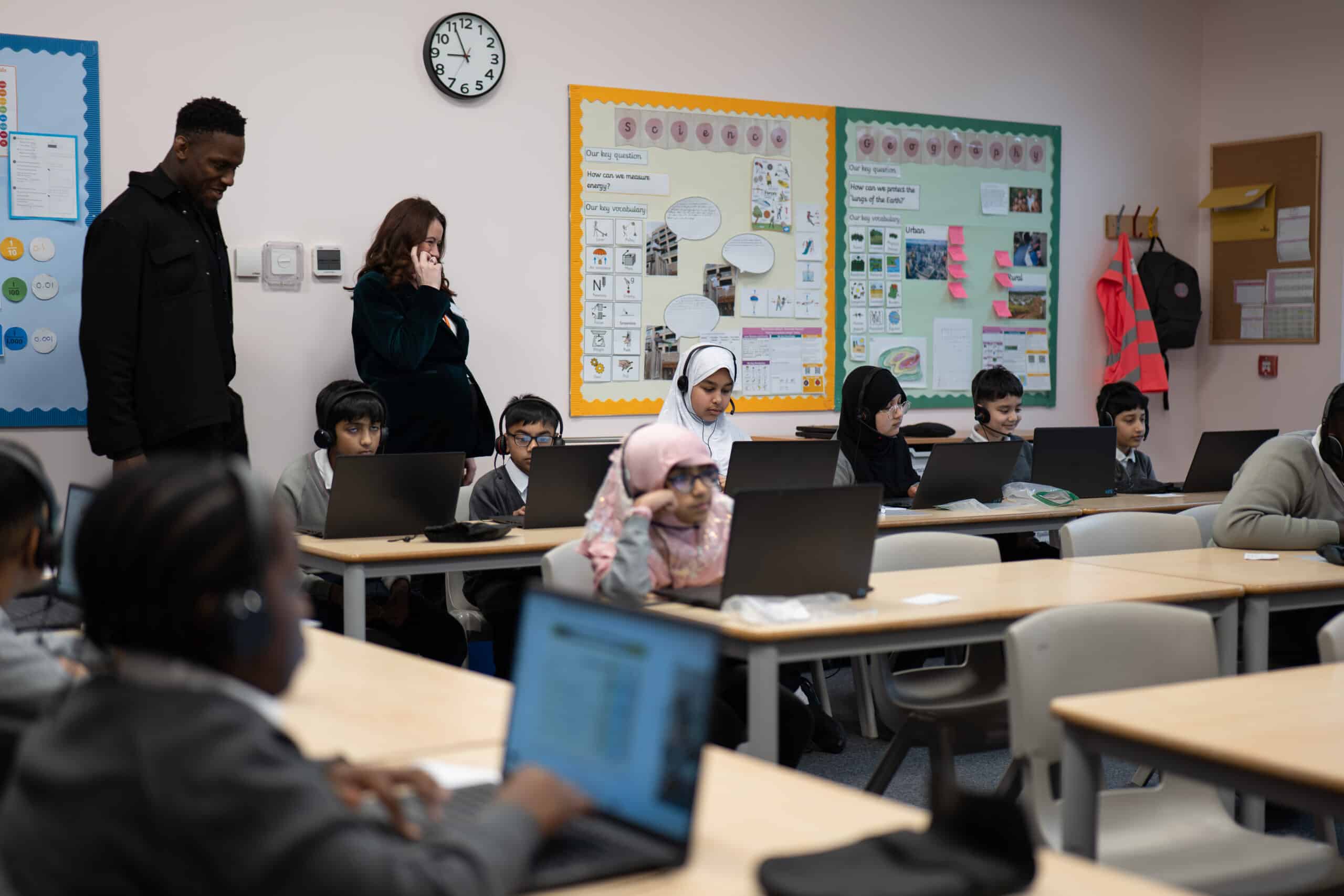
On 25th March, Maro visited St Paul’s Way Trust and The Clara Grant Primary School to see the programme in action. We sat down with him to discuss why this mission is so personal, the “heart-filling joy” of the classroom, and why education remains the ultimate tool for self-determination.

Why did you start The Pearl Fund?
We started The Pearl Fund because I’ve always felt a responsibility to give back – but to do it in a way that is sustainable, long-term, and where you can clearly see the impact on young people’s lives.
Why did The Pearl Fund decide to partner with Action Tutoring?
We were looking to partner with a UK-based organisation to help deliver our programmes in London. The Pearl Fund is all about education, and there were so many synergies with what Action Tutoring was doing – particularly in the education space and with this tuition programme.
Once we started talking, it became clear that Action Tutoring was the right fit for what we were trying to achieve.
How was it seeing a tutoring programme in action today?
I was very impressed. Very impressed by the children, by the tutors, and the work that they’re doing. It filled my heart with joy to see how engaged the children were and how much they were enjoying it. I’m very happy that I came to see it.
What difference do you think it will make for the pupils on the programme?
I think the difference it will make is enormous. These are children facing learning challenges, often from difficult socioeconomic backgrounds, so they are doubly disadvantaged. It could be the difference between passing and failing their exams.
At the age they are, it’s critical that they catch up. I was told today that many are still impacted by the effects of Covid – both in terms of their learning and the environment they were learning in. Programmes like this help accelerate that development.
What are your hopes for these pupils’ futures?
To pass their exams and to grow in confidence. But my long-term hope is that they are able to take control of their own stories. That their education gives them the ability to choose their path – whether that’s through school, university, or another route. When you have an education, you have that freedom.
What would you say to the current volunteers?
Keep going; the work that you’re doing is amazing. It is well-appreciated by the kids and everyone else involved in the programme. They’re a fundamental part of this programme because without the volunteers we wouldn’t be able to do this, so thank you.

What would you say to anyone considering volunteering as a tutor?
I think with all this type of work, you often end up getting more from it than the children! The children definitely benefit and the impact on them is huge, but in terms of what the volunteers get from it: what they experience fills their heart with joy. So, I would encourage any volunteer who is thinking about it: I think you should just try it, and if you try it, I almost guarantee that they will stay in the long term.
What would you say to schools considering programmes like this?
Do it, because the impact on the kids will be amazing! The impact on their education and their future lives will be amazing, and I think the evidence is there for all to see. I would encourage all the schools who are considering it to go for it.
Finally — why does a good education matter?
I think it is potentially the greatest vehicle we have as human beings for progression. It’s something that cuts across socioeconomic backgrounds. It cuts across borders. It cuts across race or any other social demographics. It ultimately gives individuals the power and the ability to control their future destiny, and that’s what we all want as individuals. Education is key to that.
A legacy beyond the pitch
Maro’s visit serves as a powerful reminder that the attainment gap is not just a statistic – it is a hurdle that can be cleared with the right support. Throughout our conversation, Maro highlighted that tutoring is “the difference between passing and failing” for pupils facing double disadvantages, particularly those still navigating the “learning scars” left by the pandemic.
His message is clear: education is the “greatest vehicle for progression” because it transcends borders, socioeconomic status, and race. By providing pupils with the tools to “control their future destiny,” the partnership between The Pearl Fund and Action Tutoring is doing more than just improving test scores; it is giving young people in East London the agency to write their own stories.
As Maro noted, this work wouldn’t be possible without our volunteers. Whether you are a school leader looking to close the gap or an individual looking for a “heart-filling” way to give back, the evidence is there for all to see: tutoring works.
“The tutoring has already had a positive impact on our pupils. We are seeing growing confidence, stronger engagement in lessons, and a renewed excitement for learning. Children who may have struggled are now participating with greater pride, and they’re making meaningful progress both academically and personally.”
Rubel Aloum, Principal, Clara Grant Primary School
Find out more
To find out more about The Pearl Fund and their work, please visit The Pearl Fund website.
A warm welcome to our two new trustees: Nick Brook and Richard Mann
18 March 2026
We are delighted to announce the appointment of two exceptional new trustees to our Board: Nick Brook and Richard Mann.
As Action Tutoring continues our work to narrow the attainment gap for disadvantaged young people, we are thrilled to bring these new perspectives to our leadership. These appointments come at a pivotal time for the charity, as we deepen our school partnerships and explore how emerging technologies, like generative AI, can help us scale our impact.
Our trustees are vital in ensuring our mission remains focused and our strategy remains robust. By combining high-level policy expertise with sector leadership and cutting-edge tech experience, our new trustees will help us navigate the evolving education landscape with confidence.
“I am thrilled to welcome Nick and Richard to the Action Tutoring Board. We were specifically looking for leaders who could help us strengthen our impact within the state school sector and think strategically about the future of tutoring. Both bring incredible expertise and a shared, deep, personal commitment to educational equity. I look forward to working closely with them as we write the next chapter of our story.”
Jen Fox, Action Tutoring CEO
Meet our new trustees

Nick Brook, CEO of Futures For All
Nick joins our board with over 25 years of experience across the education and public sectors. Currently the CEO of the social mobility charity, Futures For All (formerly Speakers for Schools), Nick was previously Deputy General Secretary of the National Association of Head Teachers (NAHT). In 2022, he served as the independent chair of the Department for Education’s Strategic Tutoring Advisory Group, advising Ministers on how to maximise the impact of tutoring for disadvantaged pupils.
Prior to this, he ran his own successful educational consultancy and held senior civil service positions, including at Ofsted, the Home Office, and the Teacher Training Agency. Nick started his career as a primary school teacher, working in disadvantaged schools on the south coast of England
“I have long believed in the transformational power of high-quality tutoring to close attainment gaps, and I have admired Action Tutoring’s evidence-led impact for many years. I’m delighted to be joining the Board and supporting a charity whose mission so clearly aligns with my commitment to educational equity and opportunity.” – Nick Brook

Richard Mann, CEO and founder of nerdle
As AI continues to transform the way we live and learn, Richard Mann joins our Board to provide strategic oversight of our digital development. His expertise will help us explore how AI can be developed to ensure thousands more young people can access our support and ensure we remain at the forefront of effective, ethical educational intervention in a digital age.
“I’m excited to join Action Tutoring at such a pivotal time. The charity’s evidence-based approach has already demonstrated remarkable impact for disadvantaged pupils. I believe AI has the potential to build on this foundation and significantly expand the charity’s reach. I look forward to helping the team tackle this challenge, ensuring even more children can benefit from the opportunities that specialist tutoring support can offer.” – Richard Mann
Why these roles matter
At Action Tutoring, we are continually reflecting on how to make our tutoring more effective and accessible.
- Policy and advocacy: With Nick’s extensive background in government policy and tutoring strategy, we are better equipped to champion the importance of tutoring on a national stage.
- Future-proofing with AI: Having Richard’s expertise in AI will provide us with essential experience as we embark on our pilot of AI tutoring, ensuring we explore and invest in the right opportunity for our pupils.
We are immensely grateful to all our trustees for giving their time and expertise to support our mission. Their guidance ensures that we can continue to provide the highest quality support to the young people who need it most.
Maths modelling in action
12 March 2026
What is modelling in maths? We spoke to Action Tutoring’s Maths Curriculum Coordinator, Jen Thomas, who explains the process and how we adopt it across our curriculum. We also find out more about her role at Action Tutoring.
Modelling explained
Modelling is where a teacher or tutor shows a pupil how to do something whilst sharing their thinking behind the process at the same time.
- Effective modelling is carefully structured and explicit, building step by step to reduce cognitive load.
- The modelling process should gradually move from the tutor to the pupil, building independence over time.
- AT supports tutors to model in this way through the ‘I do, we do, you do’ structure (which you can find within our workbooks and templates).
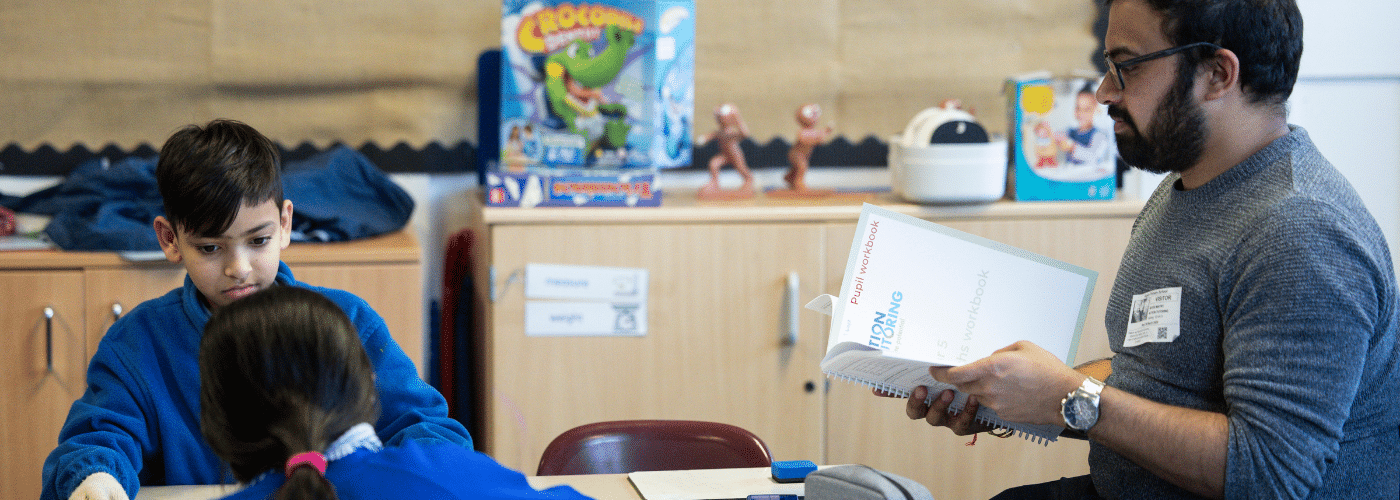
How Action Tutoring implements modelling across its tutoring programmes and curriculum
Tutor-led activities are where the tutor starts modelling, demonstrating each of the maths steps required to solve a problem. The following three terms indicate tutor-led activities in our workbooks – and where a tutor will need to take the lead:
- ‘Tutor worked example’.
- ‘I do’.
- ‘Work with your tutor’.
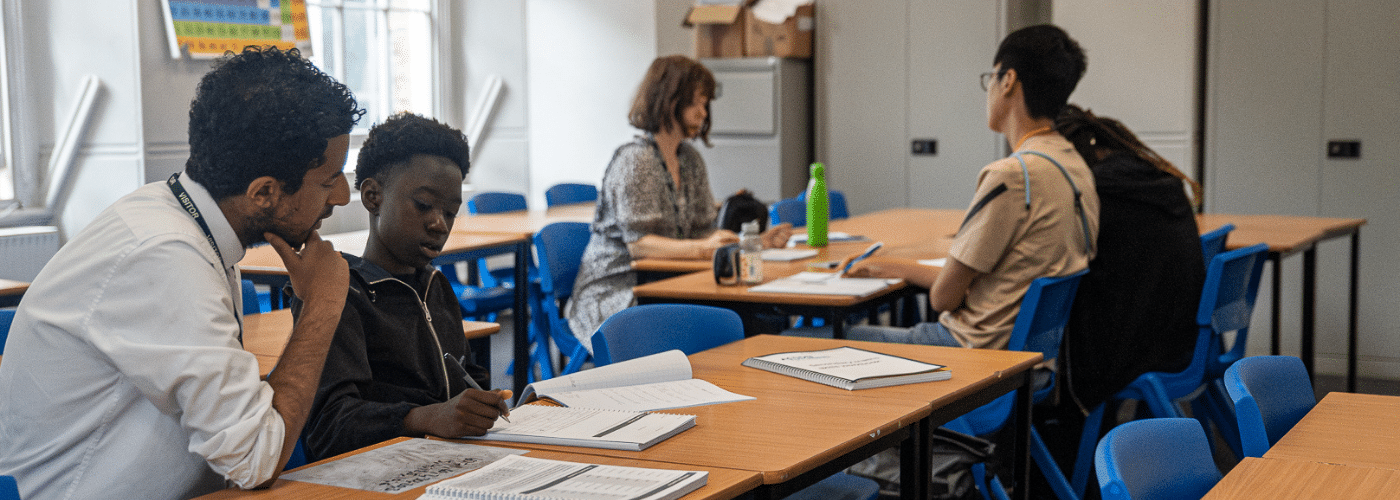
Delivering an effective tutoring model
There are three key aspects to delivering an effective tutor model:
- Write down each step of your working out.
- Provide simple visuals to help pupils follow the reasoning.
- Think aloud and use verbal questioning.
Additionally, once you have delivered the ‘Tutor worked example’, or ‘I do’, the next step is ‘we do’. This involves encouraging the pupil to try one for themselves whilst you are on hand to guide and support them.
Overall, this gradual handover reduces pupils’ cognitive load, enabling them to be successful in a low-stakes environment.

What key things do tutors need to consider with modelling?
- Remember it is really important as a tutor to adapt to the needs of the pupils you are working with.
- If they are stuck or struggling to progress independently, ensure you provide extra models – i.e. an ‘I do’ or a ‘we do’.
- Once pupils show they’re ready, only then move to the independent modelling.
- Finally, remind pupils mistakes are part of and occur during learning and by doing some more ‘we do’ examples you will succeed together.
Hone your skills
Interested in developing your modelling practice? Check back on our website and socials to sign up to the next Bright Ideas Live Workshop this spring focusing on maths modelling.
In addition, have you seen our really helpful maths tutor demonstration videos? These help Year 6 and Year 7 maths tutors to prepare for their first ten tutoring sessions. They include showing you how to complete the ‘I do’ activities (where you will model the maths to your pupils).
Check out the videos below (you can also get the full playlist via our YouTube channel).
Follow our socials
For more updates on our work, follow us on social media via the channels below.
Sofie: Gaining belonging and joy through tutoring on International Women’s Day
9 March 2026

From feeling like an outsider, to gaining belonging and joy through tutoring, as part of International Women’s Day, Action Tutoring volunteer Sofie describes her eventful education experience.
Sofie remembers the moment which “completely crushed” her. Pulled aside after one of her A Level lessons, she received devastating feedback.
“My teacher told me, ‘I’m just not sure you can keep up with the boys’,” Sofie says. “I already had fairly low confidence. Maths was one thing I felt good at, where I could relax, enjoying school, even when everything else was difficult. At the time, the comment made me question something which felt part of my identity.
“Given I was thinking seriously about my university options and had long planned to study a maths degree, hearing my teacher suggesting I select an easier subject really knocked me. Instead, I researched courses with lower entry requirements, assuming my dreams were no longer possible.”
Support from Sofie’s parents and a “fantastic, really passionate, female maths teacher” helped put those comments in context, she says.
Working today as a digital product designer at NatWest Group, Sofie reflects on how far she has come from that uncertainty.
Tutoring lifeline
Earlier in her school years, classroom chaos had already affected Sofie’s confidence. She says: “Chairs were thrown around the room. During that time, I shut down, losing love for maths and learning.”
Positivity increased when, at 14-years-old, Sofie’s parents found her a tutor; kickstarting her tutoring journey. Sofie says: “My tutor helped me fall in love with maths again. Back then both my parents and my tutor understood tutoring wasn’t about improving grades for me – it was to help me slowly rebuild my confidence and relationship with maths. Tutoring provided the right support at the right time.”
Exploring maths ideas not on the syllabus, and working with numbers, patterns and problem solving without pressure or judgement, Sofie says this tutoring experience was vital. Aged 17, Sofie returned to tutoring during her A Levels, where she says one-to-one support helped her remain calm and manage increased pressure.

“It’s unbelievable how one hour of tutoring per week helped,” Sofie says. “Exam pressure really overwhelmed me. Thankfully, my tutor helped make learning fun again. Tutoring enabled me to ask questions and build understanding at my own pace.”
With her teacher, tutor and parents’ encouragement, Sofie applied to study maths at the University of Sheffield. She adds: “I got accepted and it was one of my best ever decisions.”
Empowering girls through Action Tutoring volunteering
So where is Sofie on her tutoring journey today? Her personal experience has supported her own progression, and empowered her to give back. Joining Action Tutoring in October 2024, Sofie has tutored on several Year 6, Year 10 and Year 11 maths programmes. A charity supporting pupils from disadvantaged backgrounds with their English and maths education, Action Tutoring’s cause resonated with Sofie.
Sofie says: “When I discovered Action Tutoring, I knew I’d found a purpose. I could support young people who really needed tutoring help but weren’t as lucky as I was. Not every child has parents who can secure tutoring so it felt right to help.”
So how has Sofie found her tutoring sessions? She says one particularly memorable experience tutoring two Year 11 female pupils last year remains strong. “They were initially both very hesitant to speak up or attempt questions,” Sofie says. “Unless they felt they had the right answer, they’d stay quiet or giggle to avoid embarrassment.”
Encouraging the pupils to discuss their thinking, Sofie says this inspired change.
“By responding positively to one of the girls answering a question, I saw her confidence grow immediately,” she adds. “This meant they both gradually started answering questions more freely without anxiety, explaining their thinking, and asking questions without worrying about being wrong.
“Seeing this incredible real life impact has stayed with me. It inspired me to continue tutoring. It reinforced tutoring goes beyond improving results, it’s helping pupils, particularly girls, feel confident and capable in the world, and that they belong in any room.”
Meaningful maths
This experience underpins the foundation Sofie believes she received in maths and in tutoring itself. As a woman working within the science, technology, engineering and mathematics sector, the tutoring environment Sofie experienced as a teenager then simultaneously played a “pivotal part” in being accepted onto the NatWest Technology Solutions internship and graduate programme.

Sofie says: “Instead of focusing on what I should already know, my school tutor emphasised curiosity and understanding why things worked. By stepping outside the syllabus and making maths enjoyable, my confidence naturally returned. This mindset has really helped me in employment, where I adopt different approaches and apply transferable problem-solving skills useful far beyond the classroom.”
Being grateful for this rich experience, how does Sofie feel this has influenced her tutoring?
“I consistently focus on creating a calm, supportive environment where pupils feel safe asking questions,” she adds. “I also reward pupils for showing their thinking, reminding them mistakes are part of learning.
“I’m mindful someone can be capable while still doubting themselves, so when I tutor, I work on confidence, encouraging pupils’ curiosity, as much as maths itself. Enabling pupils to see they belong in maths and can succeed feels vital, because I personally know how powerful that belief is.”
Skills through signing up
It’s not only giving back to pupils through tutoring for Sofie. It’s also how much volunteering has helped develop Sofie’s own skillset. “Tutoring has sharpened my awareness of how confidence shows up, or not, in groups,” Sofie adds. “I’ve applied this knowledge when mentoring junior designers and graduates at work. Drawing on my tutoring experience, I’ve tried to create safe one-to-one or small group spaces where colleagues can share ideas in a less pressured way, while celebrating their work and reinforcing their contributions so they feel confident and valued.”
And how much does Sofie recommend tutoring to those considering signing up?

Volunteer now
By signing up, volunteers can tutor either online or in person for just an hour a week (no previous tutoring or teaching experience is required).
Follow our socials
For more updates on our work, follow us on social media via the channels below.
What we have achieved: Our 2024-25 impact report
26 February 2026
We are delighted to share the benefits our pupils and schools have received from tutoring over the 2024-25 academic year, as highlighted in our latest impact report.
Read on to understand how tutoring continues to benefit those we support.
Solid foundations
Committed to narrowing the attainment gap in English and maths with tutoring as a proven solution, we have built up a robust evidence base, over our 14 years in operation.
Our latest impact report shows we have a foundation of evidence and a proven solution – tutoring with volunteers works.
Read our 2024-25 impact report

The results
In 2025, our Year 6 pupils closed the attainment gap in Reading, while our Year 11 pupils defied the odds at GCSE; with both groups outperforming disadvantaged peers nationally.
Primary schools: Our Year 6 impact
After attending 10 or more sessions with Action Tutoring, 73% of pupils achieved the expected standard in their maths and 81% achieved the expected standard in their Reading SATs. In fact, for the first time this year, we didn’t just narrow the attainment gap with this year group, we closed the attainment gap completely in Reading. Our Year 6 pupils met the national reading standard at the same rate as their non-disadvantaged peers.
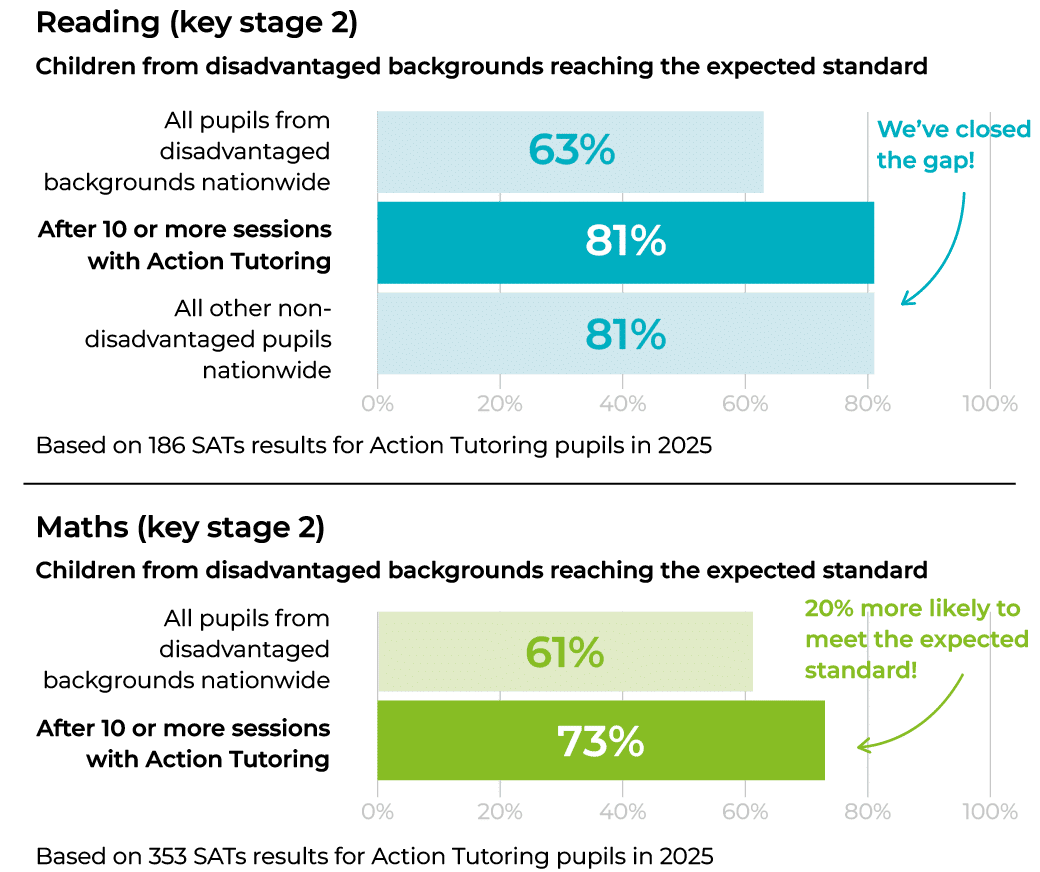
Action Tutoring pupils were 20% more likely to meet the expected standard in maths and 29% more likely to meet the expected standard in Reading than other disadvantaged pupils nationwide in their SATs.
Teachers select pupils to take part in Action Tutoring programmes that are at particular risk of not meeting this benchmark in their key stage 2 SATs. This makes their achievement all the more meaningful.
Secondary schools: Our Year 11 impact
60% of pupils passed their GCSE maths and 57% passed their GCSE English (after attending 10 or more sessions with Action Tutoring), compared to 53% and 52% of disadvantaged pupils nationally.
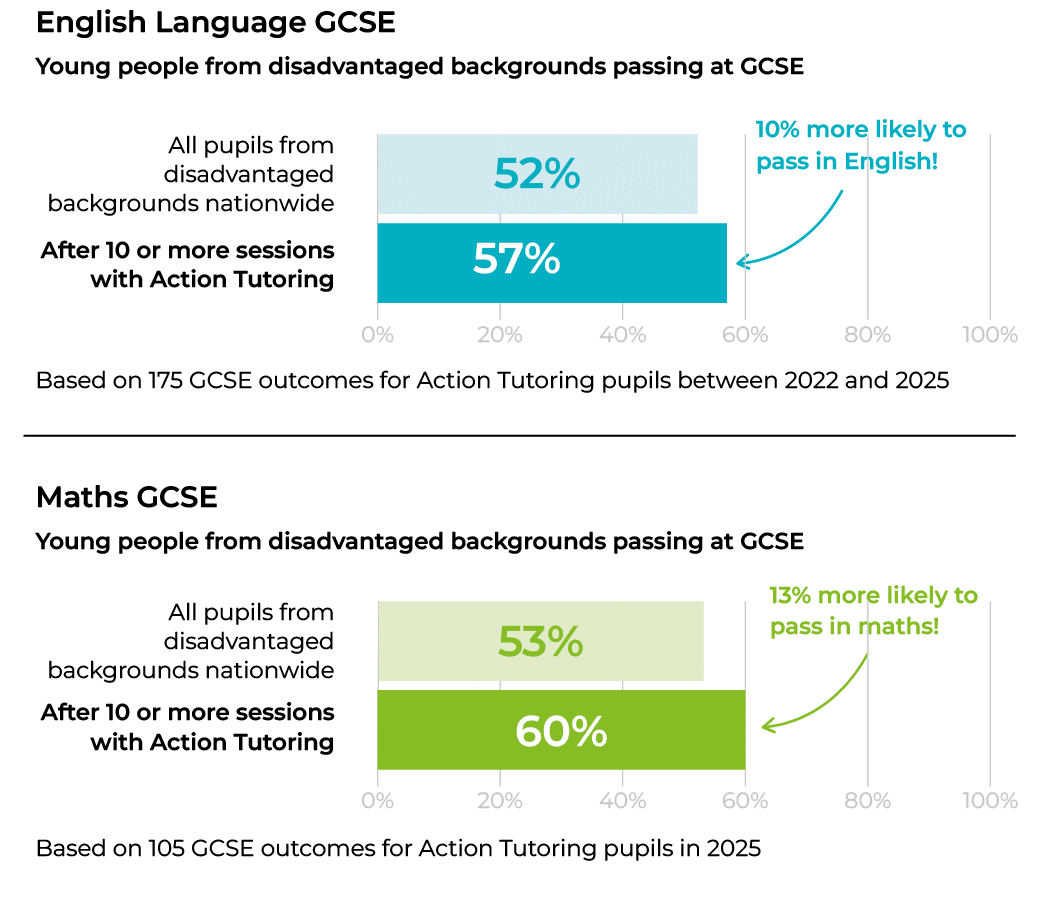
Action Tutoring pupils were 13% more likely to pass GCSE maths and 10% more likely to pass English than disadvantaged peers nationally.
An independently quality-assured study found our pupils achieve similar outcomes whether they are tutored online or face-to-face.
Unrivalled scale of impact
In addition to these impressive achievements by pupils on our programmes:
- We mobilised 1,401 tutors to deliver 42,479 sessions, reaching over 3,700 high-potential pupils, through partnerships with 102 schools.
- We were recognised as the “School Partnership Provider of the Year” at the National Tutoring Awards 2025.
- We expanded our delivery into more high-need, underserved communities including Blackpool, Cumbria, Devon, and Dorset.
Excellent endorsements
We are proud of the strong partnerships we develop with schools across the country. But don’t just take our word for it:


Thank you
We hope you enjoy reading through the publication and reflecting on our work together. We want to thank everyone involved for their contribution to Action Tutoring’s mission across the 2024-25 academic year. Every child has the potential. Your family’s income should not determine your chances of success. Our impact data consolidates our commitment to lead on closing the attainment gap across 2025-2026.
Looking ahead
As part of the 2025-26 academic year, we are looking forward to reflecting on – and sharing the results of – our Education Endowment Foundation evaluation. The evaluation’s randomised controlled trial format is continuing to assess the impact of tutoring for Year 7, 10 and 11 pupils facing disadvantage, including how this improves their attainment and attitudes. We are excited to learn more about the findings from our innovative approach in 2027.
However, there are challenges which still remain.
Schools are grappling with real-terms funding shortfalls due to rising costs. Consequently, school leaders are forced to make impossible choices, including cuts to vital staffing and beneficial programmes. These reductions disproportionately impact disadvantaged pupils, further compounding the attainment gap. While there was welcome news of the two child benefit cap being scrapped in the 2025 Autumn Budget, school revenue funding was not increased.
While this definitely is a positive step, we still need your support. Read on below to find out how you can help.
Get involved: Ways you can join our mission
There are various ways you can help us to build a brighter future through tutoring. Find out below how you can become involved.
Sign up to volunteer
Ready to volunteer on one of our programmes?
By volunteering for just one hour a week, either in school or online, you will:
- Transform the lives of pupils from disadvantaged backgrounds.
- Give pupils hope in their education.
- Share that lightbulb moment, when a pupil exclaims, ‘I get it’.
- Experience the joy of tutoring.
Thank you!
Spread the word
We would love you to spread the word on all that we do with those you know. Whether it’s your friends, family, colleagues, or someone you know who works in education or at a school, it all helps.
Here are some other ways you can support us this year.
Share our blog
One of the best ways to spread the word on what we do, is by reading and sharing our blog posts.
Whether case studies, policy and advocacy, our curriculum, or fundraising, there’s always something worthwhile.
Recommend us to a school
Do you know of a school, or a teacher who could benefit from our work? Why not recommend us to them! They can simply email: schoolenquiries@actiontutoring.org.uk, call 0300 102 0094, or send them the link to the form below.
Follow our socials
Want to get social and keep up to date on all things impact at Action Tutoring? Simply click on the icons below to follow our channels and share our social posts today.
Empower the next generation from your desk: How Payroll Giving powers Action Tutoring
6 February 2026
February is Payroll Giving Month. It’s a time for charities, payroll giving agencies and professional funding organisations to come together to raise awareness of the scheme amongst employers, employees and charities. Indeed, Payroll Giving is the easiest and quickest way to support pupils on our programmes and our work.
At Action Tutoring, we believe that no child’s life chances should be limited by their background. We support Payroll Giving as an easy and efficient way to help us change the lives of under-resourced young people across the country through high-impact maths and English tutoring. Even a small monthly contribution enables us to plan ahead and adds up to make a real difference in a child’s life.
Payroll Giving explained
Payroll Giving (sometimes known as Give as You Earn) is an easy and tax-efficient way of making regular donations to the causes you care about straight from your gross pay. All UK registered charities are eligible to receive donations via the scheme.
When you donate to a charity through Payroll Giving, your donation is deducted from your gross salary before income tax is applied. This means you pay less tax as it is only applied to the remaining amount. Charities also do not need to claim Gift Aid on donations made from gross pay. Payroll Giving is especially efficient for medium and higher rate taxpayers who wish to make larger donations at a lower cost without the added hassle of having to tell HMRC about their giving to adjust their personal allowance.
For example, those on a 40% tax rate could reclaim £8 from their tax bill on a £20 pledge, effectively reducing their net contribution to £12. Whether your rate of tax is higher (45% allows £9 tax relief from £20) or lower (20% allows £4 tax relief from £20), a donation through Payroll Giving will go further at less of a cost to you.
Please note that Action Tutoring are not tax experts and cannot provide tax advice. Anyone considering donating via Payroll Giving should check their tax position and consider seeking professional advice.
Payroll Giving benefits
- It’s tax free.
Payroll Giving is deducted from your pay before tax, so your gift will go even further. Donating to charities tax-free directly through your salary is the most tax-efficient way to give.
Please note, Action Tutoring are not tax experts and cannot provide tax advice.
- It’s effortless.
It’s easy to set up and the donation is automatically taken from your gross income every time you’re paid. You can increase or cancel your donation at any time through your payroll department.
- Your donations stop automatically if you change jobs or retire.
You don’t need to contact your organisation or Payroll Giving to let them know when you change jobs or retire. You’ll be able to set up Payroll Giving again if your new employer takes part in the scheme. If you’re retiring, your employer may be able to continue your donation through your pension.
- Your employer may match your donation.
Many workplaces offer to match their employees’ donations. Check with your employer to see if they can make your donation go even further.

How to get involved
Regular donations are vital for the futures of the young people we support.
You can set up Payroll Giving by following these three easy steps:
- Check your employer is signed up to a Payroll Giving Agency, like the Charities Aid Foundation.
- Ask your payroll team to set you up on Payroll Giving. It’s as simple as ticking a box on your payroll system.
- Choose Action Tutoring as your charity of choice and set the amount you want to give each payday. No matter how big or small, your donation will make a difference.
Related content
Beyond the page: Why the ‘National Year of Reading’ must prioritise disadvantaged pupils
27 January 2026
This year, the Education Secretary and the National Literacy Trust launched the ‘National Year of Reading’ campaign, aimed at tackling the worrying decline in reading for pleasure, which has dropped to its lowest level in over 20 years. In 2025 just 25% of boys and 39% of girls, aged 8-18, say they enjoy reading in their spare time.
While the campaign aims to get the whole nation reading, we must be explicit about who stands to gain the most. Research strongly suggests that reading for pleasure is one of the most powerful tools we have to dismantle educational inequality. But for the children we support, those facing disadvantage, the barriers to picking up a book are higher than ever.
The ‘silver bullet’ for social mobility
It is a striking statistic: reading enjoyment is a stronger predictor of a child’s educational success than their family’s income. When a child reads for pleasure, they aren’t just passing time; they are building the cognitive foundations for life. According to the OECD (Organisation for Economic Co-operation and Development), fostering this habit is a critical lever for social mobility. The potential impact is staggering – modelling suggests that if every child in the UK read daily, we could boost the economy by £4.6 billion annually.
Yet, for many disadvantaged pupils, “reading” has become synonymous with “stress” or “testing,” rather than discovery.
Breaking the barriers
If we want the ‘National Year of Reading’ to be a success, we must address the ‘Book Poverty’ currently impacting disadvantaged families:
- Resource gaps: Over 1 in 10 disadvantaged children do not own a single book. With the cost-of-living crisis, books have become a luxury many families simply cannot afford.
- The library lottery: Primary schools in deprived areas are significantly less likely to have dedicated library spaces, and community libraries continue to face closures.
- Lack of agency: Pupils often don’t have a choice over the texts they read and they’re often not aligned to their interests. Without autonomy and choice, reading feels like a chore rather than an escape.
Reading is often viewed as a task rather than a leisure activity. When we over-emphasise mechanics at the expense of magic, we lose the very pupils who need that spark the most.

Sparking the joy
At Action Tutoring, our approach avoids high-pressure ‘round-robin’ reading, which can induce anxiety. Instead, we focus on:
- Tutor modelling: Tutors read aloud first, demonstrating fluency and expression. This reduces the ‘cognitive load’ for the pupil, allowing them to focus on the plot and characters rather than just decoding words.
- Low-stakes engagement: Techniques like ‘echo reading’ and ‘paired reading’ create a safe space where mistakes don’t feel like failures.
- Building connection: By using diverse, relevant extracts – from Wolf Wilder to modern stories – we help pupils find themselves in the pages.
One of our Year 6 pupils recently shared that she challenged herself to read 100 pages in a single day, inspired by a text we shared in a session. That isn’t just academic progress; it’s a life changed.

A call to action
As national attention turns toward literacy this year, disadvantaged pupils cannot be an afterthought. Targeting resources, funding, and programme design toward these children is not just a matter of equity – it is the most effective use of public investment.
If we truly want to close the attainment gap, we must place those facing the greatest barriers at the heart of the ‘National Year of Reading’. Only then can we ensure that every child, regardless of their background, has the chance to get lost in a new adventure.
Some inspiring charities who are doing great work to support pupils facing disadvantage with their reading include:
Visit their sites to find out more.
Follow our socials
For more updates on our work, follow us on social media via the channels below.
Sustainability goals: Our commitment
12 December 2025
COP30, the United Nations’ 30th Climate Change Conference, concluded last month. World leaders met in Belém, Brazil to discuss pressing topics such as emission reduction pledges, protecting vulnerable communities, and empowering every sector to contribute positively to climate action.
Our commitment to sustainability

Action Tutoring’s mission to close the educational attainment gap underpins our commitment to sustainability. In January 2024, we founded our cross-departmental Sustainability Working Group.
The group meets regularly throughout the academic year to discuss Action Tutoring’s contribution to sustainability. The UN’s Sustainable Development Goals (SDGs) have provided a bedrock for these discussions. We are proud to say Action Tutoring directly contributes to four of these sustainable development goals:
- 4: Quality education.
- 8: Decent work and economic growth.
- 10: Reduced inequalities.
- 11: Sustainable cities and communities.
An exciting opportunity

We were recently invited to take part in a programme hosted by Heart of the City, a responsible business charity dedicated to supporting small and medium-sized businesses on their sustainability journeys. The charity provides expert training and support to SMEs and supply chains of larger organisations empowering them to create more inclusive workspaces, tackle social inequalities, and get started on their net zero journeys.
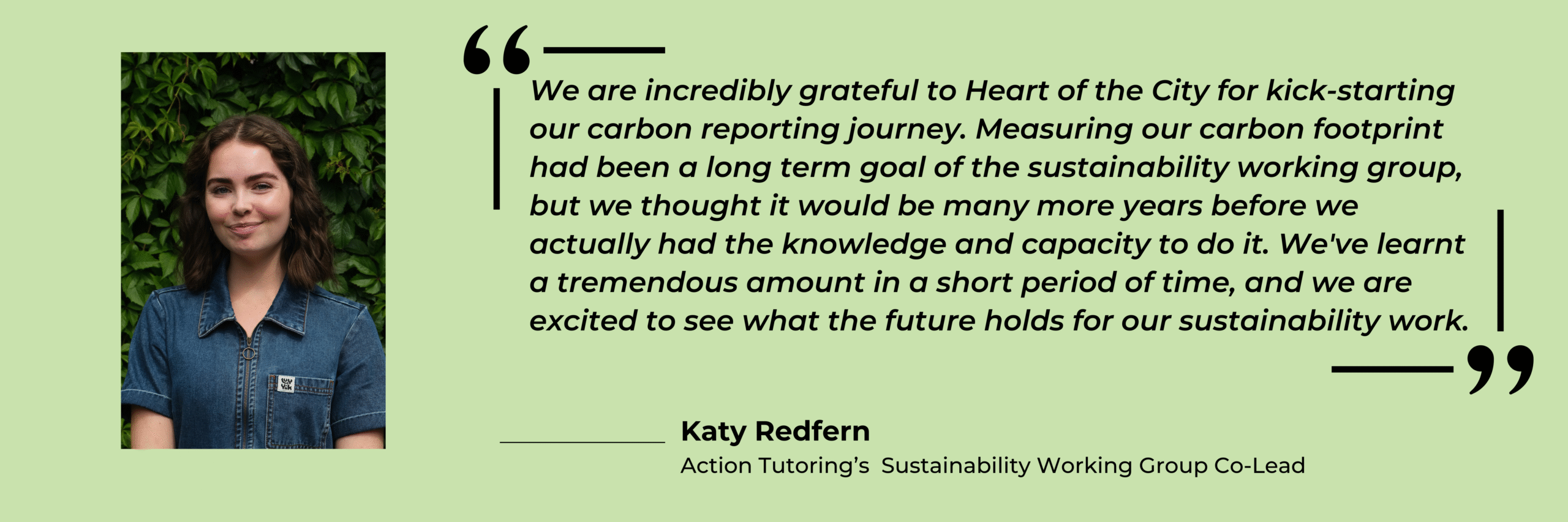
This unique opportunity enabled us to think about how Action Tutoring can contribute to yet another Sustainable Development Goal – 13: Climate action. As highlighted at COP30, carbon accounting (the process of measuring both direct and indirect greenhouse gas emissions) is a crucial step organisations must take to understand their environmental impact.
We are very grateful to Heart of the City for helping us complete our first carbon baseline, a snapshot measurement of our total greenhouse gas emissions. Our calculations show that in Academic Year 24-25, our emissions totalled 205.25 tonnes of CO2e. This figure is a good starting point for our future sustainability work. We believe this is a reasonable output relative to our organisation’s size and considering the scope of our operations.
What’s next?
Now we have our initial carbon baseline, the Sustainability Working Group is refining Action Tutoring’s data collection processes. This is to:
- Achieve a deeper understanding of our carbon output.
- Form an impactful climate action plan for reducing our emissions where possible.
Our volunteers can look out for the launch of our Tutor Travel Survey at the end of the term. The survey will gather information on how our in-person tutors travel to programmes. This will give us increased clarity about the emissions resulting from this activity. We will also be reflecting on staff travel tracking and collaborating with our contractors to gain more accurate data on our indirect emissions.
As a charity committed to enhancing the futures of young people, Action Tutoring prioritises maintaining a planet that can support equitable, prosperous and resilient lives. Thank you to Heart of the City for helping our team develop the skills and resources needed to contribute towards our vision for a sustainable future.
Find out more about Heart of the City
If you would like to find out more about Heart of the City, email info@theheartofthecity.com.
Find out more about our charity
Action Tutoring at Labour Party Conference – how tutoring is integral to education and economic growth
3 October 2025
Leading education voices have come together at this year’s Labour Party Conference to outline a dynamic vision for the future of tutoring.

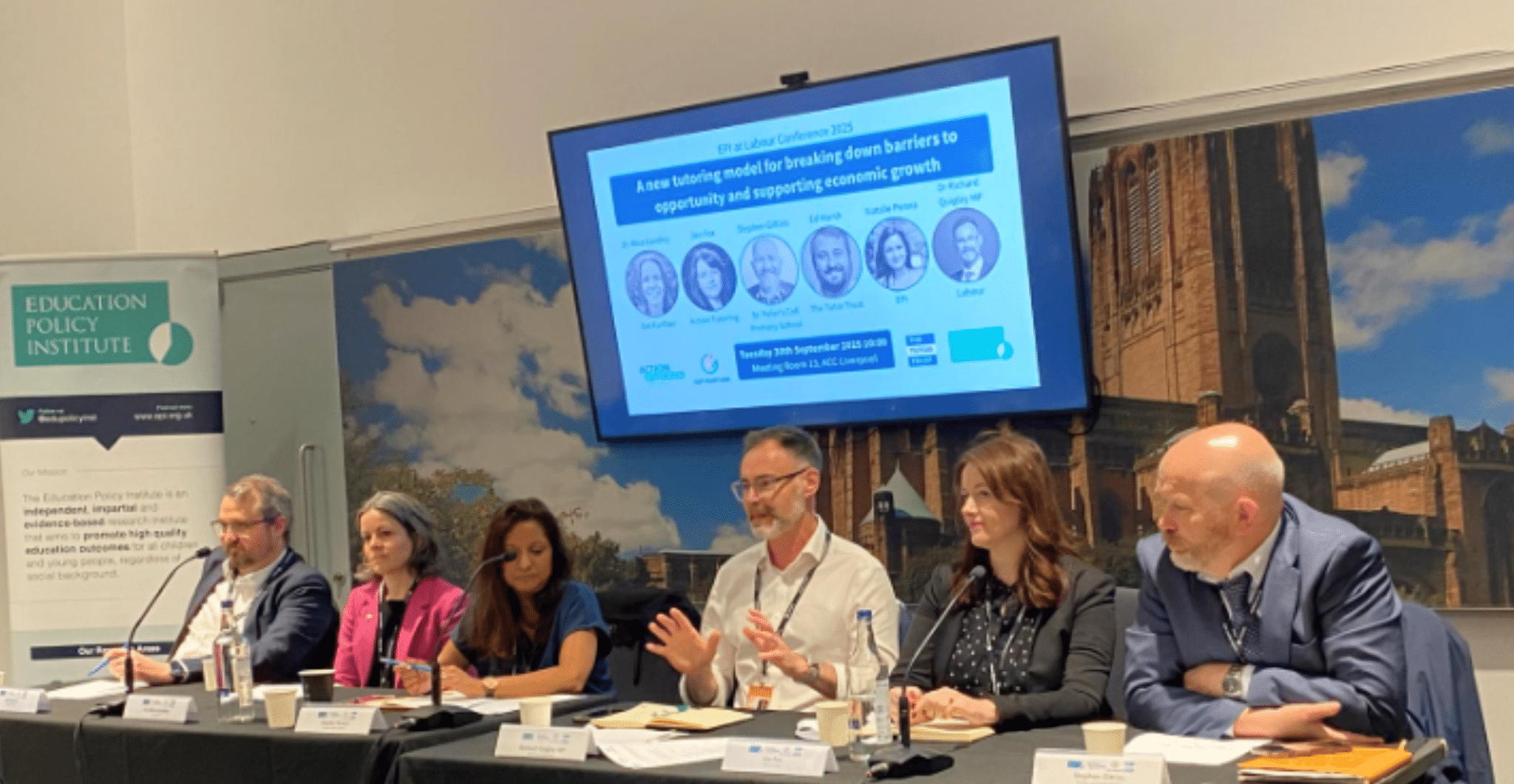
Action Tutoring partnered with the Education Policy Institute, Get Further and Tutor Trust and Richard Quigley, MP for the Isle of Wight, at the event in Liverpool on Tuesday, 30th September, where they held a panel on ‘a new tutoring model for breaking down barriers to opportunity and supporting economic growth’. Powerful testimony was shared by Steve Gittins, Executive Headteacher from St Peter’s CoE in Newcastle, who has partnered with Action Tutoring for many years, having seen first hand the difference it makes to his pupils.

the Labour Party Conference with Tutor Trust CEO, Ed Marsh,
Get Further’s Dr Alice Eardley, the Education Policy Institute’s Natalie Perera,
Dr Richard Quigley, MP for the Isle of Wight, and St. Peter’s CoE Primary School’s Stephen Gittins
(executive headteacher at one of our partner schools).
Why and what now?
The topic comes amidst increasing challenges facing the UK economy and education sector, including:
- Inequality continuing to rise.
- Young people from disadvantaged backgrounds are far more likely to achieve lower grades than their peers and far less likely to progress to higher level study or sustained employment.
Tutoring is one of the most effective interventions for addressing these challenges by closing the attainment gap for under-resourced young people. But following the end of funding through the National Tutoring Programme and 16-19 Tuition Fund income in 2024, schools have struggled to access it. This means pupils facing disadvantage are falling further behind their non-disadvantaged peers, including within GCSE maths and English.
With the national attainment gap significantly wider now than at any time in the last 12 years, policymakers, school leaders and education experts are collaborating to address what a purposeful approach to tutoring can look like.

Labour Party Conference in Liverpool.
Action Tutoring CEO, Jen Fox, said: “I’m delighted to have had the opportunity to attend the Labour Party Conference and discuss the transformational impact tutoring can have on those facing disadvantage. With our fantastic partners at the Education Policy Institute, Get Further and Tutor Trust, we have outlined how integral a role tutoring can play in growing the economy alongside increasing equity in our education system.
“As highlighted by evidence from the Education Endowment Foundation, tutoring continues to be a key intervention in helping to narrow the attainment gap and in reaching disengaged young people.
“We believe that by adopting a state-funded tutoring model, this can help achieve the Labour Government’s ambitions of sustainable and strategic change, growth, and delivery of its five missions for Britain, including within education, by breaking down the barriers for opportunity at every stage.”
Tutoring’s economic benefits
And the argument for state-funded tutoring isn’t just a social justice issue; the benefits to the economy are clear. In a 2024 paper, Public First calculated that for every £1 spent on tutoring, £6.58 is returned to the economy. In a climate where economic growth is everything that a Labour Government is chasing, investing in tutoring seems like the closest you get to a sound investment.
Find out more and get involved
Highlights from our dedicated summer fundraisers
2 October 2025
Fundraisers nationwide tackled incredible challenges this summer. From endurance bike rides to mountain treks, discover the epic efforts they went to, to support pupils and help us end educational inequality.
Trekking for equity: QBE’s National Three Peaks Challenge
Action Tutoring is the proud UK community partner of the QBE Foundation. We’re delighted that through this partnership, QBE Insurance’s incredible colleagues have united to support our cause.
Congratulations to the second team of QBE colleagues who conquered the National Three Peaks Challenge in August. The challenge entails climbing the three highest peaks in England, Scotland and Wales. This includes an impressive 23 mile walking distance and a whopping 3,064 metres (10,052ft) climb. Find out more on the Three Peaks Challenge website.
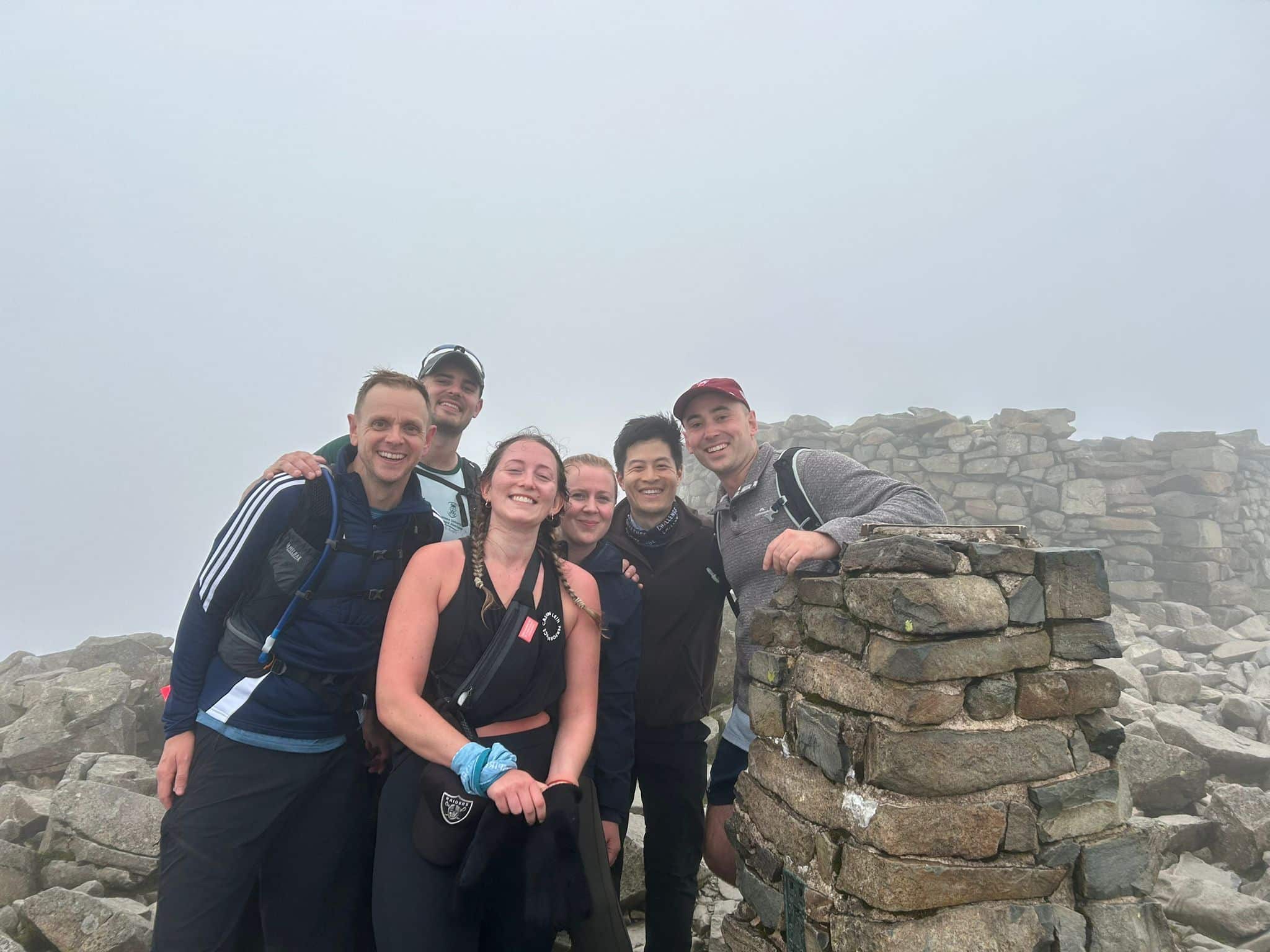
“Back from one of the hardest and most rewarding things I’ve ever done. We were blessed with great weather for two to three peaks, amazing teammates and drama-free journeys in between, and finished in an incredible 22 hours 13 minutes.” –
Hannah Haddrill, Business Manager at QBE and Three Peaks fundraiser.
From scaling Snowdon, Scafell Pike, and Ben Nevis, an astounding £7,796.95 was raised, including generous match-funding from the QBE Foundation.

Cycling for 24 hours: Nich’s South Downs Way Double Challenge
A huge congratulations to our Director of Finance and Operations, Nich, who tackled the epic South Down’s Way Double, raising over £1,500.
Watch Nich’s video below for an insight into his preparation for the challenge.
Nich completed the 200 mile challenge back in Winchester in an incredible 24.5 hours.
Reaching new heights at the Tottenham Hotspur Stadium
A courageous team of six faced a daring challenge – walking 47 metres above the Tottenham Hotspur pitch. Completing this challenge at the Premier League football club’s North London home, heights included moving over a daunting glass walkway! One of the team, Adam, also fearlessly took on a free-fall abseil from the stadium.

Raising over £1,600, the team had a great time and said it was “only a little nerve-wracking!”

10k and 21k distances completed for our pupils
This summer has seen many amazing fundraisers take on 10k and half marathon distances to support our vital work. This includes The Saucony London 10k, Great North Run, The Big Half and Cheltenham Half Marathon.

“The race had an incredible festival atmosphere with live music en route and huge crowds cheering us on! Running it for a great cause made it all the more enjoyable and rewarding.” – Mollie, Action Tutoring Corporate Partnerships Manager and Great North Run fundraiser.


“It was an amazing experience and knowing that I was running for such a meaningful cause made it even more enjoyable and rewarding!” – Kalina, QBE Data Engineer and Big Half fundraiser.
And a huge good luck to our QBE team taking on the Royal Parks Half Marathon in October!
Want to get involved? Our events for 2026
We’re really pleased to soon be announcing yet another upcoming exciting spring and summer 2026 event calendar. If you’d like to hear about fundraising with us, you can subscribe to our newsletter below!