
Connecting pupil wellbeing and attainment
14 May 2026
As we mark Mental Health Awareness Week, it is an ideal time to reflect on the intrinsic link between a pupil’s emotional resilience and their academic outcomes. We know that for school leaders, the pressure to meet progress measures and close the attainment gap is constant. Yet, as every practitioner sees daily, a pupil’s ability to engage with the curriculum is inseparable from their mental and physical wellbeing.
At Action Tutoring, we view pupil wellbeing and attainment as two sides of the same coin. By providing consistent, supportive interventions, we aim to help schools remove the barriers that prevent young people from focusing on their learning. This week, we are highlighting how a holistic approach – one that prioritises a child’s sense of security and confidence – is often the most effective way to unlock their true academic potential.
The evidence: What the data tells us
The link between a pupil’s mental health and their ability to learn is backed by significant research. According to UK government guidance, pupils with better health and wellbeing generally achieve better academically.

Specifically, the Department for Education (DfE) highlights that:
- Pupils with no emotional or behavioural problems at age 11 achieve, on average, the equivalent of one grade higher at GCSE than those with even mild problems.
- Schools that implement an “integrated” approach to wellbeing – where mental health support is woven into the school culture – see a marked improvement in attendance and engagement.
The Children’s Society also notes that “subjective wellbeing” (how a child feels about their own life) is a significant predictor of their future educational trajectory. If a child feels safe, supported, and heard, their “working memory” is freed up to focus on algebra or creative writing, rather than navigating emotional distress.
The attainment gap: A health and wealth divide
While wellbeing matters for every child, the stakes are highest for those facing socio-economic disadvantage. Pupils eligible for Free School Meals (FSM) are statistically more likely to face “adverse childhood experiences” (ACEs) or persistent “toxic stress” related to financial insecurity.
Pupils from low-income households are more likely to experience mental health challenges but are often less likely to have access to private support or extracurricular outlets that build resilience. For these pupils, the classroom can either be a place of further stress or a vital sanctuary. This is where targeted intervention, such as small-group tutoring, plays a dual role.
How tutoring bridges the gap
Tutoring is traditionally seen as an academic intervention, but at Action Tutoring, we see the profound impact it has on pupil wellbeing and attainment simultaneously.
For a pupil eligible for Free School Meals (FSM) who may be struggling with confidence, the presence of a consistent, encouraging volunteer tutor can be transformative.
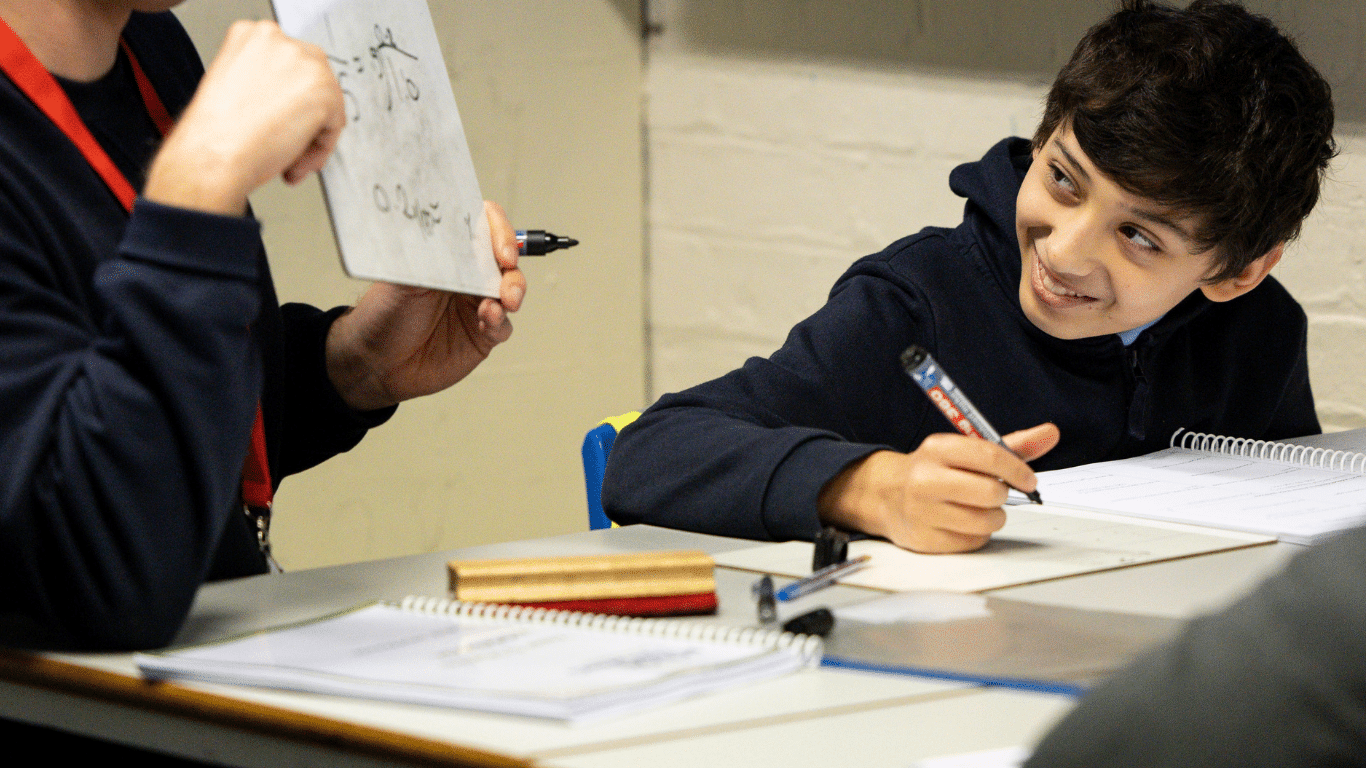
Our tutors provide:
- A safe space to fail: In a class of 30, a pupil may be too anxious to raise their hand. In a 1:3 tutoring session, they can make mistakes and ask “silly” questions without fear of judgment.
- Emotional regulation: Mastering a difficult maths problem doesn’t just improve a grade; it provides a “win” that boosts self-efficacy and reduces school-based anxiety.
- Positive role modelling: For volunteers, their impact goes beyond the curriculum. They are stable, supportive adults who show pupils that their education – and their future – is worth investing in.
“I quite look forward to having a little chat, because sometimes it’s not always about the work.”
Kobie, Year 6 pupil at Holy Trinity Primary School in Dorset
A note to our volunteers
If you are reading this and considering how you can help, remember that your time does more than just move a pupil from a Grade 3 to a Grade 4. You are contributing to the holistic health of a young person.
By showing up for one hour a week, you are telling a disadvantaged pupil: “You matter, I am listening, and I believe you can do this.” That boost in confidence is often the exact spark needed to ignite academic progress.
“Tutoring has been really helpful. I’ve definitely noticed the difference since my last mock and I feel more confident already!”
Year 11 pupil, Newfield Secondary School in Sheffield
Help us support the whole child
As we look toward the next academic year, our mission remains clear: ensuring that no child’s background limits their potential.
Schools: We are here to partner with you to provide the evidence-based support your FSM pupils need to flourish. Get in touch here.
Volunteers: We need your passion and your empathy to help us reach more young people than ever before. Express your interest in volunteering next academic year here.
Why our curriculum is in expert hands
7 May 2026
When a school partners with an external provider, the biggest concern for any Head of Maths or English could very well be alignment. Does this provider understand our curriculum? Do they know the specific hurdles our Pupil Premium students face? Can they speak the same pedagogical language as our staff?
At Action Tutoring, the answer is a definitive yes. That’s because our programmes aren’t just “delivered” to schools – they are crafted by former school teachers and leaders who have spent years on the front lines.
From Head of Maths to Curriculum Coordinator: Jen

One of the key architects behind our maths provision is Jen, our Maths Curriculum Coordinator. Before joining Action Tutoring, Jen spent a decade in the classroom, including five years as a Head of Maths in a Bristol secondary school.
Jen’s journey to Action Tutoring was born out of the same challenge many of our partner schools face today. In 2018, she was tasked by her Senior Leadership Team to find evidence-based, sustainable ways to support disadvantaged pupils.
Fast-forward to 2025, she joined the Action Tutoring staff team as the Maths Curriculum Coordinator (maternity cover):
“I remained deeply committed to removing the barriers preventing pupils facing disadvantage from succeeding. After ten years of teaching, I reached a point where I wanted to step outside the classroom, but I didn’t want to leave the mission behind. Discovering the Action Tutoring model left me immediately impressed.”
Jen, Action Tutoring Maths Curriculum Coordinator
From in-school Curriculum Leader to Curriculum Coordinator: Maria

Our English provision is led by a similar level of expertise. Before joining the Action Tutoring team, our English Curriculum Coordinator Maria spent 12 rewarding years at an all-girls comprehensive school in Liverpool, serving as the Curriculum Leader for English.
With over a decade of experience in classroom teaching and behavior management, she brings a deep understanding of what it takes to engage young people in literacy. Much like Jen, her move to Action Tutoring was driven by a desire for a flexible work-life balance while still making meaningful use of her extensive experience in education.
“The social mission of teaching has always been incredibly important to me,” she explains.“I knew that this sense of purpose needed to remain a central element of my career.
“Action Tutoring offered the perfect opportunity to combine my pedagogical and teaching expertise with a role that aligns closely with my values. Working for an organisation that is deeply committed to supporting disadvantaged young people and helping them to flourish within their communities has been both inspiring and fulfilling.”
Maria, Action Tutoring English Curriculum Coordinator
Speaking the same language
Our workbooks and tutor training are designed with a “teacher’s eye.” Jen has been able to translate her favourite parts of being a Head of Maths – specifically curriculum design and gap analysis – into the resources our tutors use every day.
“Maths and English are the ultimate keys for young people. Passing GCSEs opens doors to opportunities that would otherwise remain locked. We know that only 43% of disadvantaged pupils currently pass both subjects, compared to 73% of their wealthier peers.
That 30% gap is exactly what we are here to close.”

What schools say
“I really value how reflective and responsive Action Tutoring is. For example, the English Language booklet was adapted to match exam questions more closely and I was invited to be part of a conversation on how baselines and progress checks are used by the Action Tutoring team.”
Charlotte Bowyer, Assistant Headteacher at King Ecgbert School in Sheffield
“During Year 6, children sit previous SATs papers on a regular basis. In our most recent assessments, the tutored children had all improved significantly with their Arithmetic scores, with some doubling their previous achievements.
During our Maths lessons, I also regularly hear children saying ‘well, that’s what my tutor said to do!’ as they tackle a problem, which is great testimony to the impact that Action Tutoring is having on our children and their learning.”
Jill Hanna, Year 6 teacher at Whitehouse Primary School in Newcastle
Find out more
Interested in a 2026-27 programme? Visit our schools page or send an enquiry.